Word Choice Habits That Make People Sound More Intelligent
Cognitive ease, not vocabulary size, is what actually signals competence to listeners.

Reaching for "commence" instead of "begin" doesn't make anyone sound smarter. It makes them sound like they're reading off a vocabulary flashcard, and listeners can tell the difference in about half a second. This piece is about the actual mechanics of sounding intelligent when you talk: a set of specific, trainable habits in word choice and delivery that shift how listeners judge your competence in real time, backed by research that keeps landing on the same uncomfortable conclusion. Bigger words aren't the lever. Something else is.
A Preply survey of 1,012 Americans found that 53% admitted to using a complex word specifically to sound smarter, and 58% said they'd deployed fancy vocabulary in a job interview or networking event for the same reason. Everyone's doing it, in other words, which raises an obvious question: if the trick is that common, is it actually working? CNBC covered communication research suggesting the opposite. When listeners can process what you're saying without friction, they rate you as more capable, not less, and vocabulary size has almost nothing to do with it. Psychologist Paul Penn put it more bluntly than most academics are willing to: "Trying to sound clever is a good way of sounding stupid." That's the pivot this whole piece turns on.
How listeners decide someone is intelligent, according to research
Cognitive ease is the engine here, and it works almost the opposite way most people assume. When a listener doesn't have to strain to follow what you're saying, they don't credit their own comprehension. They credit your intelligence. This is sometimes called the fluency principle, and it explains why a directly worded sentence can outperform one built from more complex, formal wording even when the more complex version is, technically, more precise.
Verbal fluency research backs this up with actual cognitive infrastructure. Semantic clustering (grouping related words together automatically), the switching between those clusters, and the speed of lexical retrieval all reflect neural processes that listeners pick up on unconsciously, even if they couldn't name a single one of those terms if you asked them at a dinner party.
Delivery carries its own signal, running in parallel to word choice and sometimes overpowering it. Pitch, pacing, and pause communicate before the content of a sentence even registers. Research has noted that vocal qualities like pitch tend to shape how confident and authoritative a speaker is perceived to be, independently of what they're actually saying. Research on vocal tone goes further: how you sound can influence perceived leadership more than the content of the speech itself.
So intelligence perception runs on multiple channels at once. Word choice matters, sure, but it's operating inside a delivery context that either amplifies it or completely undercuts it. The good news, if there is one: both channels are trainable. Neither is fixed at birth like eye color or a weird laugh.
The habits that shift how listeners hear you
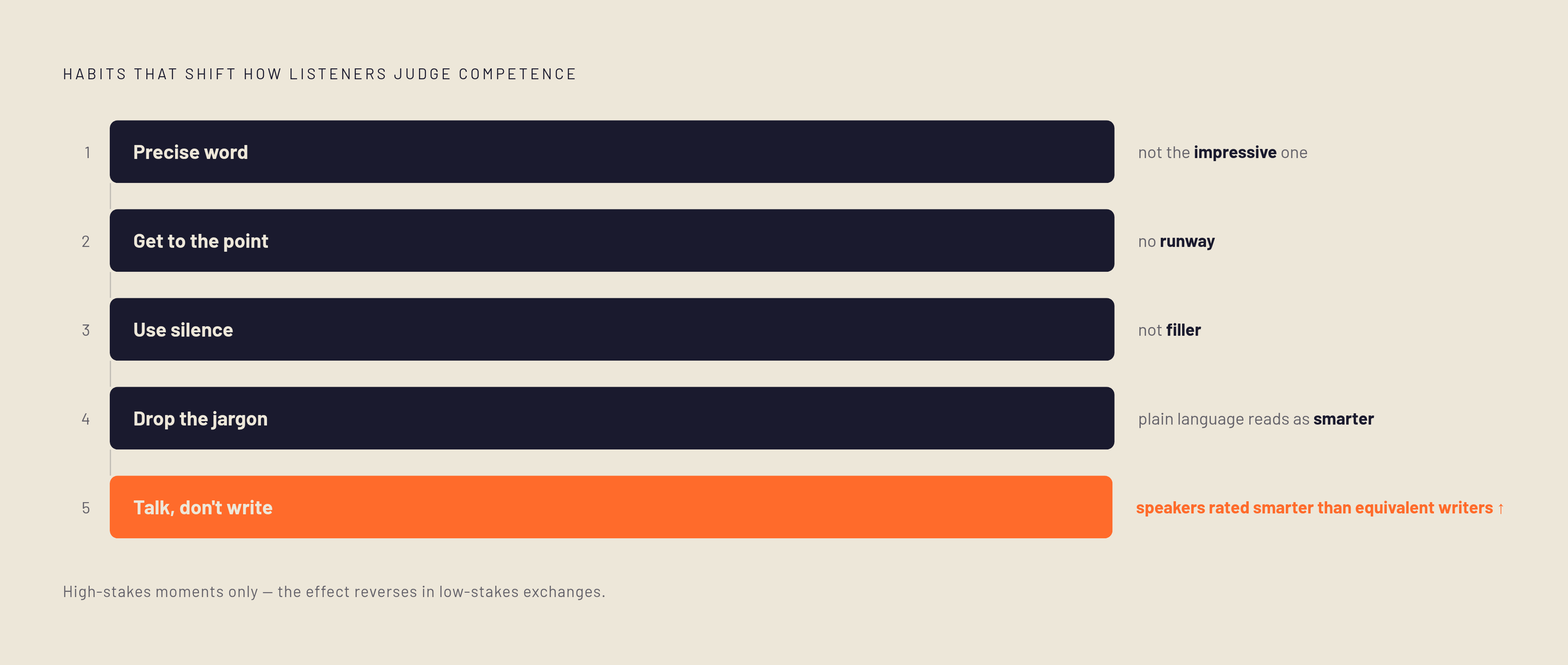
Habit one is choosing the precise word, not the impressive one. Active voice beats passive almost every time in a professional setting. CNBC's 2025 reporting on this used a clean example: "Sales increased this quarter" lands harder than "Sales have continued to maintain their upward trajectory." Same information, wildly different cognitive load on the listener. Precision reduces effort, and reduced effort reads as command of the subject. Misusing a word, meanwhile, is the fastest way to torch that impression instantly: someone who says "simplistic" when they mean "simple" has just demonstrated the exact incompetence they were trying to paper over.
Habit two is getting to the point without a runway. Clarity itself signals organized thinking. A convoluted setup doesn't read as depth, it reads as uncertainty, and listeners know the difference even if they can't articulate why. CNBC's communication experts frame the advice simply: figure out what you're actually trying to say, then make it easy for someone else to follow. That's not dumbing anything down. It's removing friction, which is a different project entirely. Boards, investors, hiring managers, they read directionless preambles as a lack of conviction. Leading with the conclusion is a structural habit, not a stylistic flourish.
Habit three is using silence instead of filler. Research cited by CNBC found that unfilled pauses between words for no punctuation-driven reason make speakers sound more articulate and more educated to the people listening. Research on synthesized speech found that speech without filler words was perceived as more confident, and fillers placed in the middle of an utterance produce the least confident perception of all. Research on speech production ties filler use to word-retrieval effort, anxiety, and divided attention. Listeners read that signal even when they can't name what tipped them off.
Moderate filler use in casual conversation can actually signal authenticity, and it primes a listener for what's coming next. The target is overuse in high-stakes rooms, the kind where every hesitation gets logged against you. It's overuse in high-stakes rooms, the kind where every hesitation gets logged against you.
Habit four is dropping the jargon, especially the tired corporate kind. Managers keep telling CNBC's researchers that jargon is an immediate turn-off. Words like "leverage," "synergy," and "transformative" read as vague, not sophisticated. This is the same instinct as reaching for "commence" over "begin," and it fails for the exact same reason: complexity without precision isn't intelligence, it's noise wearing a blazer.
Habit five, and this one surprises people: talk, don't write, when you want to be seen as smart. Research on the topic found that people assume writing makes them sound smarter (no fillers, more careful phrasing, time to edit). Listeners disagreed. They rated speakers as smarter than equivalent writers. Which matters quite a bit for anyone deciding between sending an email and just picking up the phone.
Why complex vocabulary sometimes works, and exactly when it stops
Context is the whole game here. That same Preply survey found that over half of Americans say a coworker using complex vocabulary at work seems smart, and 17% automatically assume that person has more money. At work, or in school, big words can read as competence. On a date? Thirty-five percent of respondents said the same behavior comes across as pretentious. Same words, opposite verdict, purely a function of the room they're spoken in.
The specific vocabulary tells its own story. "Ambiguous," "articulate," and "exacerbate" top the list of words Americans reach for when they want to sound smart. "Capricious," "equanimity," and "sycophant" land on the opposite list, the one reserved for words people find most pretentious. Somewhere between those two lists is a line, and most people can't tell you exactly where it is until they've crossed it.
CNBC's experts offer something like a litmus test: if a word doesn't come naturally to you, it reads as fake, because it is fake, functionally speaking. Twenty-four percent of Preply's survey respondents admitted to using a word they didn't actually know the meaning of, purely to sound smarter. Twenty-four percent of Preply's survey respondents admitted to using a word they didn't actually know the meaning of, purely to sound smarter. That's a coin flip away from getting caught, and getting caught in that spot doesn't just cost you the word. It costs you everything you said in the five minutes around it.
How AI-flattened language makes authentic word choice a competitive advantage right now
Audra Nuru, a professor of communication studies and family studies at the University of St. Thomas, told Time in January 2026 that messages across LinkedIn, email, and dating apps grew "polished but oddly interchangeable" throughout 2025. Her word for it was that they'd "lost their pulse." Everything reads like it came out of the same template because, increasingly, it did.
There's data behind that observation, and it's stranger than the anecdote alone suggests. A preprint study by Masukume tracked word co-usage across 175 years of scientific literature in PubMed and Scopus. The words "delve" and "underscore" appeared together in 1,284 out of 1,299 PubMed articles in 2023 and 2024, which works out to 98.8%. Co-usage of that pairing jumped as much as 85-fold compared to every year before it, becoming a fingerprint detectable even to readers who couldn't explain the statistics behind why a sentence feels off. That's not a stylistic preference spreading organically. That's a fingerprint, and it's becoming detectable even to readers who couldn't explain the statistics behind why a sentence feels off.
This sets up the actual opportunity: when everyone's prose defaults to the same polished, forgettable template, a word that's genuinely yours becomes the thing that cuts through. When everyone's prose defaults to the same polished, forgettable template, a word that's genuinely yours, chosen for a reason specific to what you're saying, becomes the thing that cuts through. Nuru's framing captures what's actually getting lost: "the quirks, hesitations, warmth, and lived experience that tell someone, 'I'm here with you.'" That's precisely what homogenized language strips out, and precisely what makes a speaker or writer memorable in a landscape full of interchangeable competence.
Why these habits are hard to build without feedback, and what works
Filler words, jargon, and passive constructions are largely invisible to the person producing them. You don't hear your own "um" in the moment. You don't notice you've said "leverage" four times in one meeting. Awareness has to come from somewhere outside your own head, because your own head is the thing generating the noise in the first place.
A 2025 study out of a multi-institution team (City University of Hong Kong, National University of Singapore, Saarland University, Zhejiang University, Guangxi University, and INRIA) tested something called WSCoach: a wearable device giving real-time auditory feedback the instant it detected an unwanted word, filler or otherwise. Researchers compared it against a mobile app that offered post-hoc analysis after the conversation ended. Both reduced unwanted word use. But the real-time device won out over the long run, which tracks with a fairly intuitive design principle: feedback that arrives while the habit is forming beats feedback that arrives after the fact, because by the time you're reviewing a transcript, the moment that needed correcting is long gone.
Habit formation research backs up how long this actually takes, and it's not the 21 days everyone quotes at parties. Newer behavioral studies put the real average above 60 days, and Lingoda's 2025 research found that consistent, structured practice supports stronger habit formation than sporadic effort. Without repeated practice, most of what gets consciously learned doesn't stick. Consistent practice over time tends to outperform occasional intensive effort.
So the gap between reading about these habits and actually owning them gets closed by repetition with feedback, not by nodding along to an article (including this one). Daily short-form speaking practice, recording yourself, getting some kind of score or signal back, hearing your own patterns played back to you, is about the closest low-barrier version of the real-time feedback loop the WSCoach research points to as most effective. That's the environment where this stuff actually turns into a habit instead of staying a good intention.
What happens to the people who develop these habits
Something interesting happens once these habits become automatic: the deliberate performance of them disappears. Preply's data show that over half of Americans say a coworker using complex vocabulary at work seems smart, and 58% admitted to deploying it on purpose during interviews. But people who've actually built the underlying habit stop needing to deploy anything. Precise word choice just sounds like them, because at that point, it is them.
The same logic scales up into higher-stakes rooms: presentations, pitches, arguments that matter. Public speaking research points to a short list of moves that account for most of what reads as confidence: slowing down on the opening sentences, pausing deliberately after a key point instead of rushing past it, and landing one clear closing line instead of trailing off. None of that is charisma in the way people usually mean the word. All of it can be rehearsed and scored like a sport, because in a lot of ways, that's exactly what it is.
Roughly 75% of people experience some degree of public speaking anxiety, and the gap between a nervous newer speaker and a composed veteran doesn't close through some innate talent. It closes through accumulated evidence, rep after rep of a talk going fine, until the brain quietly reclassifies the situation from threat to routine.
And socially, the effect compounds. The person who speaks with precision, pauses on purpose, and sounds unmistakably like themselves instead of a corporate template is the one people remember after the meeting ends, after the interview wraps, after the date is long over. That gap, between forgettable and memorable, is what daily practice closes.
None of this is personality. None of it is some innate talent handed out at birth to a lucky few. It's a set of habits, built the same way any habit gets built: by doing the thing, repeatedly, with something or someone telling you when you got it wrong. Wanting to sound smarter doesn't do that work. Practice does.
Sources
- Words That Make You Sound Smarter in 2025
- People who sound smart do 7 things when talking to others, say communication experts
- 12 Communication Habits to Ditch in 2026
- The Impact of AI on Scientific Literature: A Surge in AI-Associated Words in Academic and Biomedical Writing
- WSCoach: Wearable Real-time Auditory Feedback for Reducing Unwanted Words in Daily Communication