Vocal Variety Techniques Used by Captivating Speakers
Vocal variety is a learnable craft with five mechanical tools that work together to hold attention.
A well-structured speech delivered in a flat monotone is just an essay read out loud. The fix most speakers reach for, more energy, more passion, more personality, is the wrong one. Vocal variety, the deliberate use of pitch, tone, volume, pace, and pause, is a craft with specific, learnable mechanics. Everything below breaks down what those mechanics are, how they work in the brain, and why the speaker who "just needs to loosen up" almost always actually needs something more mechanical: a wider pitch range, a planned pause, a slower two seconds at the exact right moment.
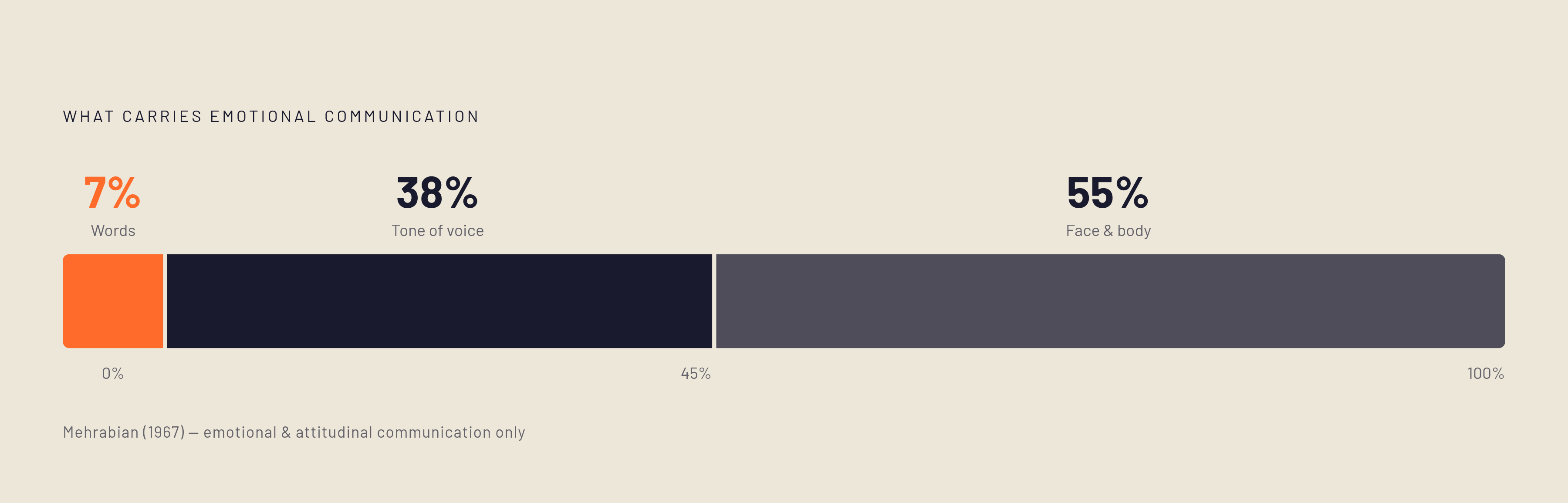
Consider the math on how a message actually lands. Research on emotional and attitudinal communication, not communication in general, found that tone of voice carries 38% of the weight, facial expression carries 55%, and the literal words carry just 7%. That figure gets misquoted constantly, usually stripped of its context, but even accounting for the caveat, the ratio says something real: how something is said outweighs what is said by a wide margin, at least when feelings and attitude are on the line.
The audience has usually made up its mind before a speaker gets that far, anyway. Something like 70% of people form an impression before a word is spoken, based on posture, expression, the way someone walks to the podium. From there, a speaker has roughly 27 seconds to confirm or wreck that first impression. Everyone knows what failure sounds like here: the monotone teacher, the droning lecture, the eyes glazing over around minute four. That image is universal because of what monotony does to a brain wired to notice change and ignore sameness. It costs a speaker on four fronts at once: engagement, retention, credibility, and perceived authority. None of that gets fixed by finding a better personality. It gets fixed by learning the moves, which is the actual subject of this piece.
What vocal variety means: the five components and how they work together
Vocal variety breaks into five pieces: pitch, tone, volume, pace, and pauses. Each does a different job, and the mistake most speakers make is treating them as interchangeable, as if turning up any one of them covers for the other four.
Pitch is highness or lowness, the piano-key quality of a voice, unrelated to loudness. Tone is the character and texture of the sound, and it gives away whether a speaker actually believes what they're saying or is just reciting it. Volume ranges from a near-whisper to full projection. Pace is speed, the rhythm that compresses a room's energy or gives it room to breathe. Pauses are the odd one out, the only component built entirely from the absence of sound.
Most speakers pick one or two of these and ride them for an entire talk. Someone gets loud when they mean to seem passionate, or someone slows down when they mean to seem thoughtful. Rarely does anyone combine pitch, pace, pauses, and projection into one coordinated instrument, and that combination, not any single technique done well, is what separates a mediocre talk from a good one.
Variety is not noise, and treating a flat, unvaried delivery as acceptable costs a speaker the audience's attention, since a booming volume spike with no setup or a pitch jump from nowhere reads as artificial fast. A booming volume spike with no setup, a pitch jump from nowhere, reads as artificial fast, and audiences notice fake before they notice flat. The target is a natural range that serves the content.
How pitch signals meaning before words do
Pitch tells an audience how to feel roughly half a second before the words confirm it. A rising pitch signals excitement, urgency, a question forming. A dropping pitch signals seriousness, weight, the moment a lesson lands. Audiences pick up on this almost involuntarily, since pitch does its interpretive work before the brain finishes parsing the sentence.
The common failure is what might be called the stuck pitch: a speaker finds a comfortable register early and never leaves it. After a few minutes the audience stops processing individual words, because nothing in the sound signals which ones matter. It is the auditory equivalent of a page with no punctuation and no paragraph breaks, everything running together into one gray wash of syllables.
Good storytelling delivery treats pitch like a map of the emotional arc: high at the surprise, low at the resolution, the shape of the voice telegraphing the shape of the story. Research on pitch variation and attention backs this up directly: speakers who vary pitch hold audience attention better across the length of a talk than speakers who don't. None of this calls for an artificially high or low voice. The goal is range within a speaker's own natural register, not theatrical extremes that sound like an impression of oneself.
A useful exercise: go through any speech and mark the two or three points where the emotional temperature actually shifts. Those are the spots that need a pitch change. Everywhere else can sit closer to a natural baseline, and it should, because a talk that treats every sentence as a peak has no peaks left.
Pace as a pacing instrument: when to accelerate and when to brake
Pace works the way tempo works in music. A section that speeds up creates urgency and forward motion, useful for a fast sequence of events or a build toward a climax. A section that slows down gives a moment weight, tells the audience this part deserves full attention, and creates space to actually think.
The real power move is the contrast between fast and slow, not either one on its own. It is the contrast between them. A quick run of sentences followed by one slow, deliberate line lands harder than either pace would alone, because the brake itself becomes the emphasis. Speed up for six sentences, then plant one, and that single sentence does more work than the six before it combined.
Running an entire talk at one pace, whichever pace that happens to be, produces the same flatness a single unchanging pitch produces. Too fast the whole way through and the audience feels steamrolled. Too slow the whole way through and attention drifts. One fix, borrowed from scriptwriting practice: mark up a script in advance, noting exactly where to speed up and where to plant a slower, heavier sentence, so the shifts are planned rather than left to whatever adrenaline shows up that day.
Pace also does quiet cognitive work that has nothing to do with drama. Slowing down at a genuinely complex point, a statistic, a technical term, a multi-step argument, gives the audience's working memory time to catch up. Slowing down at a genuinely complex point is traffic control for information the brain needs a beat longer to file, and skipping it is the reason a technical talk can be accurate and still completely unfollowable. It is traffic control for information the brain needs a beat longer to file, and skipping it is the reason a technical talk can be accurate and still completely unfollowable.
The pause, the only technique that requires a speaker to do nothing
Pauses come in three flavors, and each does something distinct. A pause before a key point builds anticipation, telling the audience without saying so that something worth their attention is arriving. A pause after a key point lets the idea settle instead of getting buried under the next sentence. A pause mid-sentence creates tension, holds the room, makes whatever resolves the sentence feel earned instead of assumed.
New speakers avoid pauses almost instinctively, because silence on stage feels like the machine has stalled. The instinct is to fill the gap: an "um," a stray filler word, a rushed sprint to the next sentence. That instinct is the single most common mistake among speakers still building their delivery, and it costs them, because held silence communicates something no sentence can: that what was just said deserves a second before the talk moves on. Filling every gap is a reflex worth unlearning specifically. It is a reflex worth unlearning specifically.
Think of pauses as punctuation rather than dead air, placed the way a comma or a period gets placed on a page, deliberately, not out of nerves. Les Brown gets pointed to often as a speaker who shifts pace and pitch deliberately rather than plowing through a talk at one register. In Rita Pierson's TED Talk "Every Kid Needs a Champion," pace and pause work together to do more than the words alone ever could.
Saying less, more slowly, with real silence built in, usually lands harder than saying more.
Volume and projection: the dial, not the switch
Volume works like a dial, adjusted constantly against the room, the moment, and what a given sentence actually needs. Treating it as a switch is where a lot of otherwise well-prepared speakers lose the room without noticing.
Raising volume emphasizes a key point, signals urgency, or marks the moment an idea clicks, the loud "eureka" beat that snaps a room's attention back. Lowering volume does something closer to the opposite: it creates intimacy, pulls listeners forward physically as they lean in to catch what is being said more quietly. A dropped volume level often earns more engaged attention than a raised one, simply because the audience works slightly harder to hear it.
But a whisper only functions as a technique if there is somewhere to drop from. A speaker who talks quietly the entire time has no floor to fall through, so the technique disappears into the background noise of itself. Strong projection earlier in a talk is what makes the soft moment later register as an actual shift instead of more of the same.
Deep, diaphragm-driven breathing is the mechanical basis for having any volume range at all, the physical foundation that gives a voice power without strain. Tone quality matters here too: a voice that is strained, rough, or breathy reads as weak or negative no matter what the words say, which is the actual argument for vocal warm-ups as basic maintenance on the instrument rather than an actor's affectation. A floor matters as much as a ceiling. Speaking too softly across an entire talk does not read as calm authority. It reads as uncertainty, every time.
How gestures and physical delivery amplify or undermine vocal delivery
That 55% figure for body language and facial expression, again specific to how feelings and attitudes get communicated, points to something practical: voice and body have to move together, or the whole performance reads as false even when a listener cannot say why.
Try producing real vocal variety while standing completely still, arms locked, with no gesturing. It tends to come out flat and forced, like a radio recording played through a mannequin. A strong gesture on a key word, by contrast, tends to accompany genuine vocal variation, because body and voice naturally move together when a speaker is fully engaged with what they are saying. Gesture, posture, and vocal modulation working in sync are what make a story feel immersive instead of performed.
The reverse shows just as clearly. When tone signals one emotion and the body signals another (calm voice, tense shoulders), audiences register the mismatch even without naming it, and the whole delivery starts to feel hollow, the vocal equivalent of a smile that doesn't reach the eyes.
Research out of Princeton found that when someone tells a story, the listener's brain activity starts to mirror the speaker's, a kind of neural coupling: engagement as a measurable synchronization bet... Research out of Princeton found that when someone tells a story, the listener's brain activity starts to mirror the speaker's, a kind of neural coupling: engagement as a measurable synchronization between two brains, not a metaphor for attention. That is part of why rehearsing a speech sitting down, reading flatly off a script, misses something real. The body needs to be part of the rehearsal, not bolted on the night before.
What happens in the brain when these techniques are used and why audiences remember more as a result
The brain is built to notice change and tune out sameness. That is not a metaphor about attention spans so much as a hardwired feature, and it explains directly why flat delivery kills retention regardless of how good the content is. A voice that never shifts in pitch or pace gives the brain nothing new to register, so eventually it stops registering anything.
Pitch variation specifically, research on pitch variation suggests, helps maintain attention across the length of a presentation, which lines up with the change-detection idea: variation is the exact signal the brain sits there scanning for.
A chemical process drives this: neuroeconomics research from Paul J. Zak has connected emotionally engaging, character-driven storytelling to oxytocin release, the hormone linked to trust and a willingness to act on what is being he... Neuroeconomics research from Paul J. Zak has connected emotionally engaging, character-driven storytelling to oxytocin release, the hormone linked to trust and a willingness to act on what is being heard, with the emotional arc of a story priming that response. Vocal variety is part of what actually delivers the emotional content that triggers this chemistry. Flat delivery undercuts even a genuinely moving story, because the emotional cues never reach the audience's ears in a form their brain can register as emotional. A sad story told in a flat voice is, chemically speaking, not a sad story to the brain hearing it.
Virtual delivery raises the stakes on all of this rather than lowering them. With a large share of speeches now happening on a screen instead of a stage, the margin for monotony gets thinner, not wider. The effect is not only external, either. Adjusting vocal patterns deliberately, widening pitch range, adding real pauses, appears to shift a speaker's own stress hormone levels during delivery, meaning vocal technique changes what is happening inside the speaker's body, not just what lands in the audience's ears. Clarity plays its own role in credibility too: listeners tend to read articulation as a marker of competence and confidence, somewhat independent of volume or content.
Why most people sound flat, and what causes it
Monotony, a single pitch, a single pace, a single volume held for the length of an entire talk, is the single most common failure in public speaking, and it is a habit rather than a personality. It forms mostly because nobody ever pointed out it was happening.
Flat inflection strips meaning out of even important information. Say a key statistic in the exact tone used for the transition sentence before it, and the audience gets no auditory cue that anything changed. They cannot tell what mattered, because nothing in the sound told them to notice.
A narrow vocal range is usually just an unpracticed range, and that distinction matters. Speakers who never push toward the edges of their pitch or volume have not discovered what is actually available to them, which makes this a training problem rather than a limitation. A lot of speakers genuinely do not know what their voice is doing while they speak, because they are inside the sound rather than hearing it the way an audience hears it. That gap in self-awareness is the deeper issue, and it is the actual argument for recording a run-through and listening back. The flatness invisible from inside a speaker's own head becomes obvious the moment it plays back through a speaker sitting on a desk.
Nerves compress all of this further, and here is where most advice gets it backwards: flatness usually is not a lack of effort or personality, it is a physical symptom of fear. Anxiety tightens the body, restricts breathing, and narrows vocal range as a direct mechanical consequence, correctable through breath work and warm-ups rather than some fixed trait a person is stuck with for life. Public speaking anxiety affects a large majority of people to some degree, and the physiological stress response, a spiking heart rate among other things, squeezes the voice into a narrower, flatter channel almost automatically. So is the monotone speaker choosing flatness, or racing through the talk at one pace and one pitch to get off the stage as fast as physically possible? Usually it is the second one. Flatness and fear are, more often than not, the same problem wearing different clothes. The fix for most "boring" speakers has nothing to do with charisma and everything to do with breath.
How to build vocal variety, the practice methods that produce measurable change
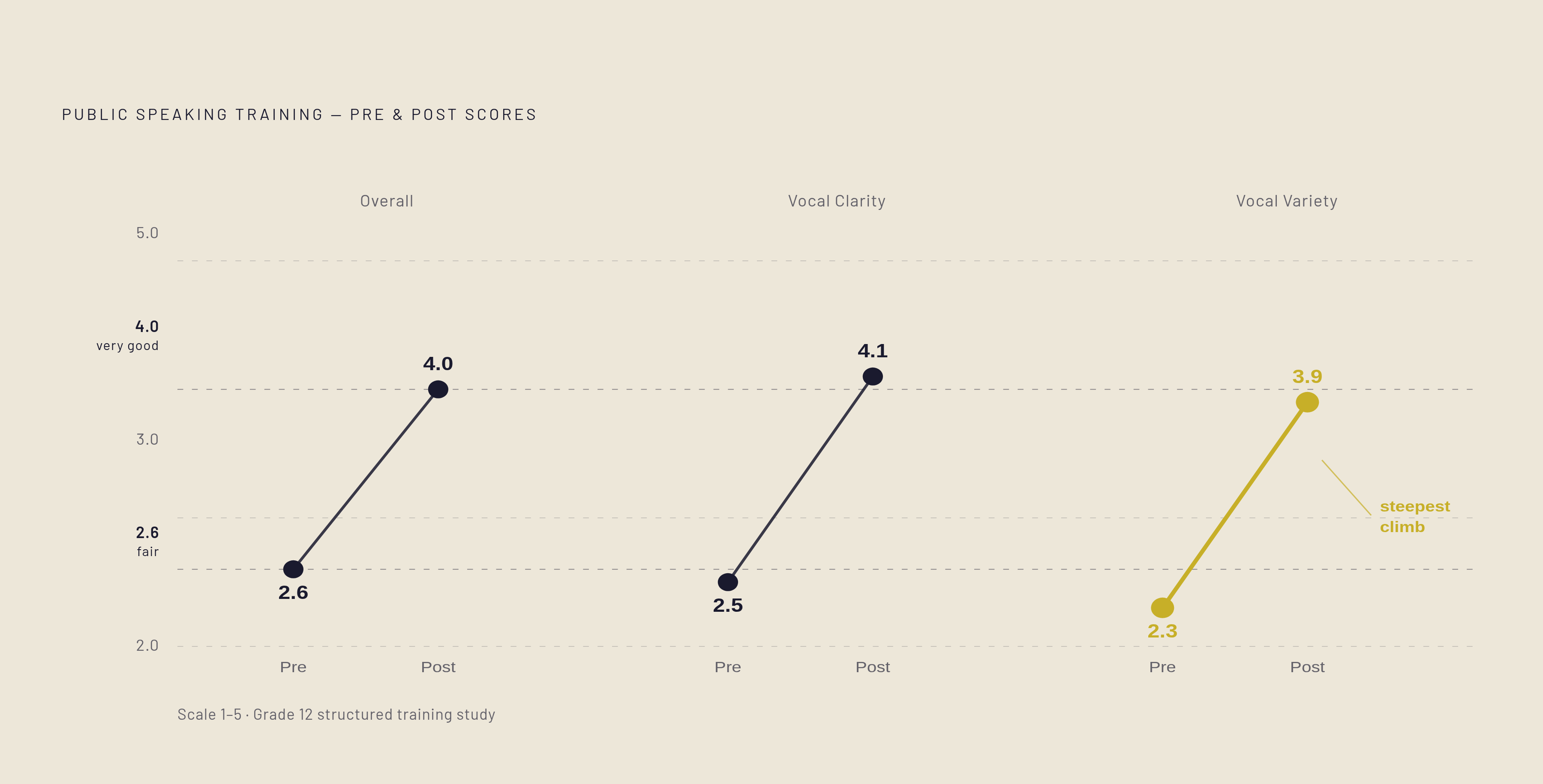
None of this stays theoretical. One study tracking Grade 12 students through structured public speaking practice, using pre- and post-assessments, found overall scores climbing from a mean of 2.6 ("fair") to 4.0 ("very good"). Vocal Clarity rose specifically from 2.5 to 4.1, and Vocal Variety rose from 2.3 to 3.9. The numeric improvement across both categories points to measurable gains from structured practice, suggesting the internal feeling and the measurable skill move together rather than one lagging behind the other.
Four methods actually produce this kind of change, and the order matters less than doing all four rather than picking a favorite.
Recording and listening back comes first. Listening back means hearing the sound rather than judging the content: is pitch actually moving, or stuck in one lane? Is pace shifting, or running at a single speed the whole way through? Are there real pauses, or just filled gaps dressed up as pauses?
Script marking comes second: going through a talk in advance and noting exactly where to speed up, slow down, drop volume, or raise it, so the variation gets planned rather than left to chance on the day.
Third is the one-sentence drill. Say a single sentence fast and loud, then slow and quiet, then reversed, then completely deadpan, then with genuine curiosity, recording each version. The words never change. The meaning does anyway, which is the entire argument of this piece compressed into one sentence and thirty seconds.
Fourth is discipline about scope: working on one element per practice session, pitch this week, pace next week, instead of trying to fix all five components at once and ending up with a performance that feels scattered rather than controlled. Vocal variety, in the end, comes down to a short list of specific moves, practiced one at a time, that reveal a range that was always technically available in the room and just never got used.
Sources
- Vocal Variety in Public Speaking: Master the Art to Engage & Inspire
- Vocal Variety in Public Speaking: Enhancing Impact Through Modulation and Technique
- The Power of Tone: How Vocal Variety Can Make or Break Your Speech - Voiceplace
- Mastering Vocal Variety in Public Speaking
- robinkermode.com
- The Role of Vocal Variety in Captivating your Audience | Presentation Training Institute
- genardmethod.com
- copextraining.com