How Swearing in Conversation Affects Perceived Credibility
Swearing signals honesty in actual moments but contradicts how people imagine credibility works.
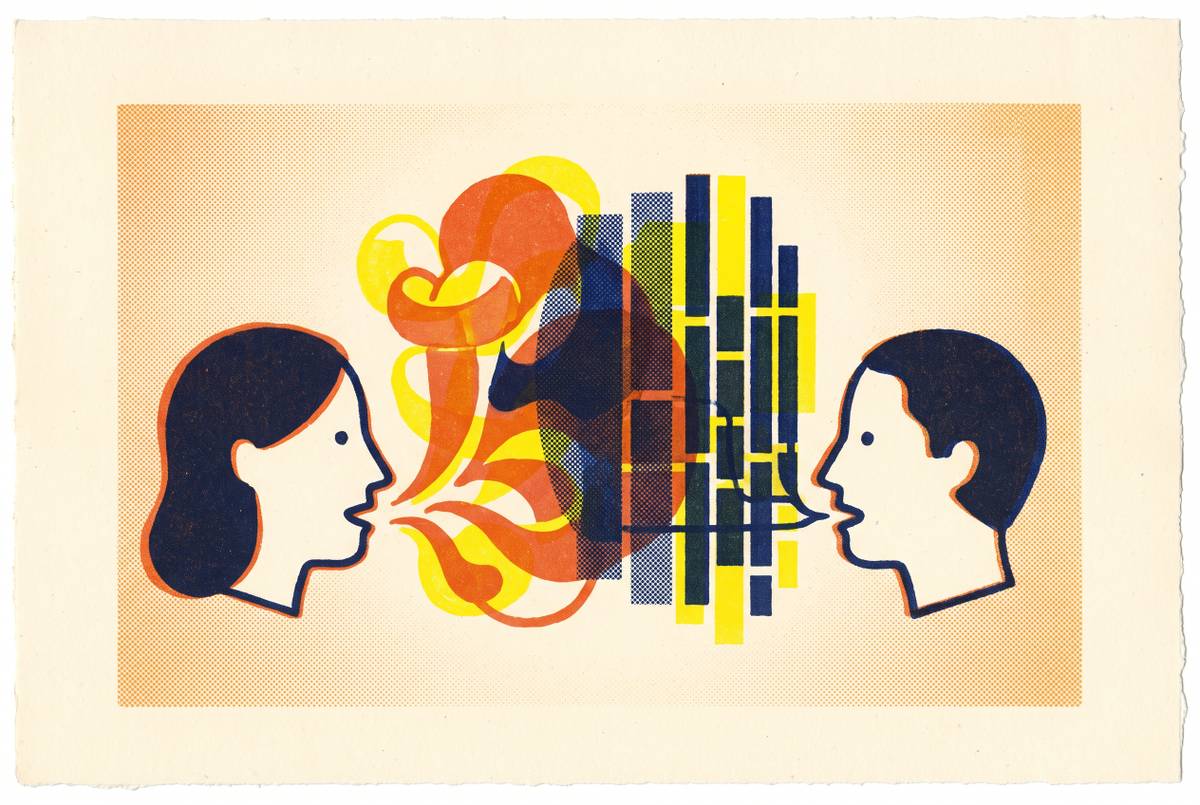
Swearing and credibility run on two separate tracks that rarely agree. Asked directly what a curse word signals, people call it a tell for dishonesty. Shown actual sworn testimony, their ratings move the other way.
Why swearing and credibility produce opposite answers depending on how you ask the question
Rassin and van der Heijden ran the experiment that pins this down in 2005. Their participants, asked outright, said swearwords might indicate someone was lying. Then the same participants read testimonies, some laced with profanity, some scrubbed clean, and rated the sworn versions as more credible than the sanitized ones. The stated belief and the actual judgment pointed in opposite directions, from the same people, in the same study.
That split is the whole puzzle this piece works through. Popular advice about professional speech, the kind that says cut the swearing if you want to be taken seriously, draws entirely from the first track: what people claim to think about profanity when you ask them in the abstract. It skips the second track, where real listeners respond to real speech. A rule built only on self-report is a rule built on how people imagine they'd judge someone, not on how they actually do it when the testimony is in front of them. The gap between those two things is where the rest of this argument lives.
How swearing functions as an honesty signal at the neurological and psychological level
Start with the mechanism, because the paradox only makes sense once the signal logic is clear. Swearing carries a cost. Dropping a taboo word risks disapproval, so a speaker willing to eat that risk reads, to a listener's gut, as someone too caught up in the moment to be stage-managing their image. Liars tend to polish. Swearing looks like the opposite of polish, which is partly why it gets mistaken for honesty.
There's a neurological layer under that social read. Sulpizio and Scaltritti found that people recognize taboo words faster than neutral ones, a timing difference that points to a stronger emotional charge attached to profanity in how the brain processes it. Words that land with more emotional weight carry more rhetorical force when a speaker uses them, which helps explain why a single well-timed curse can shift a listener's reaction more than a paragraph of careful phrasing.
One objection deserves heading off here: the assumption that people who swear are just covering for a thin vocabulary. The evidence runs the other way. Fluency with profanity tracks with broader verbal range, not against it, so the person reaching for a sharp expletive is drawing from a wider stock of language, not a smaller one. Swearing is one more register in a speaker's range, deployed because it does something softer words don't.
What swearing changes: persuasion and intensity, not formal credibility ratings
Credibility and persuasion get used interchangeably in casual conversation, and that's where this argument needs to slow down. Credibility, in the formal sense researchers measure it, covers perceived competence, expertise, and rationality. Persuasion covers something different: whether an audience's attitude actually shifts, and whether the speaker comes across as intense and emotionally engaged. Swearing's biggest effects land on the second category, not the first.
Scherer and Sagarin set this up cleanly in 2006. Participants listened to a speech arguing for lower tuition, with the word "damn" inserted at the start, at the end, or left out. Profanity at either position produced more positive attitudes toward the actual argument and a more favorable read on the speaker's intensity. What it didn't move was the audience's formal rating of the speaker's credibility. The persuasion needle moved. The competence needle stayed put.
Hair and Ozcan found a similar split running through online reviews in 2018. Reviews containing profanity read as more authentic and more honest, a credibility gain on the relational side of the ledger. Those same reviews scored lower on perceived objectivity and rationality, a loss on the analytical side. One word choice bought a gain and a cost at the same time, on two different scales.
A practical line falls out of those findings: swearing earns its keep when a speaker needs to be believed emotionally, in testimony, in a review, in a personal account of something that happened to them. It costs more than it buys when a speaker needs to be read as analytically careful, the register of expert opinion or professional assessment, where the whole point is sounding like someone who doesn't let feeling override judgment.
Where context flips the effect from asset to liability
Context decides which side of the persuasion-versus-competence trade-off actually appears, so that split only tells half the story until context enters the picture. Research published in the Journal of Language and Social Psychology found that people who encountered swearing rated the speaker as less competent, less intelligent, and less trustworthy. That study looked at casual peer conversation, not formal business settings, and it didn't break results out by field, so there's no finding here that finance punishes a curse word more than healthcare does, or that education is more forgiving than either. Formal competence judgments take a hit when profanity appears in a casual setting. It doesn't say how that hit scales once the setting gets more institutional.
Power direction complicates the picture further. The same word lands differently depending on who's saying it to whom. Profanity flowing downward, from a manager to a report, can read as aggression. Flowing upward, from a junior employee to a boss, it can read as disrespect. Flowing outward, toward a client or the public, it can read as simple unprofessionalism. One word, three different social meanings, depending entirely on where the speaker sits relative to the listener.
Women who swear face harsher judgment than men doing the identical thing, because the social taboo they're seen as breaking runs stronger. Cavazza and Guidetti's 2014 study of political candidates shows the asymmetry even inside a context where swearing generally helped: profanity from a candidate raised perceived informality and improved general impression, but that effect was stronger for the male candidate than the female one. The tool worked for both. It worked harder for one of them.
A 2024 case vignette from Washmuth and colleagues puts a face on how fine-grained context is. A physical therapist, responding to a patient's disclosure, used the phrase "fucking tough." The patient's posture opened up. Their whole demeanor relaxed. The phrase worked because it fully matched the emotional weight of what the patient had just shared. The therapist's workplace was formal and institutional, yet the moment called for profanity. A clinical setting can still contain a conversational beat where polish would read as cold, and swearing reads as presence.
Why habitual swearing destroys the very effect that strategic swearing produces
Every mechanism above depends on one condition nobody's named yet: frequency. The honesty signal runs on perceived cost, and cost only exists if the behavior is rare enough to carry weight. A curse word signals authenticity because the speaker is breaking a rule in that moment. Once swearing happens constantly, there's no rule left to break, and the signal that made it work in the first place disappears with it.
Habitual swearing starts behaving like verbal filler at that point, a reflexive "um" with a harder edge, and it dilutes whatever charge a single instance might have carried. It also invites back in exactly the associations the research above argues against: limited control, limited range, limited thought. None of that is inherent to profanity itself. It's what profanity starts to look like once it stops being an event and becomes background noise.
The professional cost of that shift is well-documented. A Harris Interactive survey of leaders and workers found real employer concern tied to habitual workplace swearing, specifically around maturity, self-control, and competence. The person swearing constantly pays that cost without collecting the persuasive upside that strategic swearing offers, because the upside depends on rarity and the habit has already spent it.
That's the move that resolves the paradox this piece opened with. The research says swearing can lift credibility. Workplace data says swearing often damages it. Both are accurate, because they're describing two different behaviors wearing the same word. One is a deliberate choice, timed to a moment that calls for it. The other is a leak, running constantly, carrying no information because it never stops.
How Gen Z's relationship with profanity changes what "credibility" means in practice
Generational shift adds to the frequency effect, and the rules stop holding still. Platforms like TikTok, Reddit, and Twitter have made swearing a standard part of casual, expressive, often comedic communication, to the point where an entire generation has calibrated its sense of what counts as authentic speech against a different baseline than the one older institutional norms were built on.
That produces a real collision. Gen Z communication style tends to prioritize emotional accuracy, saying the true thing in the true register, over polish. Older institutional norms often treat polish itself as the credibility signal, the sign that someone has taken a moment seriously enough to clean up their language for it. A single speaker can walk into a room, say the same sentence with the same curse word in it, and read as refreshingly honest to one listener while reading as unprepared to another, standing a few feet away.
None of that means younger communicators should default to swearing freely and call the problem solved. Reading a specific room accurately, to know which register actually serves the moment in front of you, matters more now that the room itself has grown less predictable than it used to be.
Knowing when a well-placed expletive serves you
Swearing well is a form of sophistication, not its absence. Swearing well demands accurate context-reading, real audience awareness, a sense of timing, and enough self-control to save the tool for the moments that actually call for it.
A few conditions tend to predict when profanity helps. An informal or emotionally intimate setting. Testimonial content that's negative or high-stakes, the kind of moment where raw reaction reads as more honest than composure would. An audience that shares cultural ground with the speaker or sits at a lower power distance from them. And a frequency low enough that the word still carries signal value when it appears, standing apart from a stream of filler.
The reverse conditions predict the opposite. Formal evaluative settings, where someone's competence is already the thing under the microscope. Audiences anchored to strong institutional norms. And any pattern of use that's tipped over into habit, where the cost that made the signal meaningful has already been spent.
Scherer and Sagarin's own framing cuts to the center of it: obscenity can make a credible speaker look more human. That sentence hinges on one condition: the speaker has to be credible already. Swearing doesn't build credibility from nothing. It amplifies credibility that's already there, the way a good punchline amplifies a joke that was already working, not one that needed saving.
Code-switching, the ability to move between registers on purpose rather than by accident, is the underlying skill this all depends on. A speaker who can land a curse word when the moment calls for raw honesty, and who can hold back cleanly when the moment calls for restraint, is demonstrating exactly the kind of contextual control that separates someone reading the room from someone just reacting to it. That range is built the way most verbal skills are built: through repetition and honest feedback, until the instinct for which register fits which room starts to feel automatic.
Sources
- Appearing credible? Swearing helps!
- Can Swearing Be Professional and Patient-Centered?
- How reviewers’ use of profanity affects perceived usefulness of online reviews
- Taboo word fluency and knowledge of slurs and general pejoratives:
- Full article: Indecent influence: The positive effects of obscenity on persuasion
- Swearing and perceptions of the speaker: A discursive approach - ScienceDirect
- Swearing and perceptions of the speaker: A discursive approach