The Psychology Behind Vocal Fry and Uptalk in Young Women
Young women aren't actually the main users of vocal fry—bias is.

This article is about the gap between what vocal fry and uptalk actually are and what people assume they mean, especially when the speaker is a young woman. The angle: these patterns are not symptoms of insecurity or sloppiness but psychologically complex social tools, shaped by belonging and power, and the penalty attached to them says more about the listener than the speaker.
What vocal fry and uptalk are, mechanically and socially
Uptalk and vocal fry get talked about as if they're the same phenomenon wearing two names, but that's the first thing to untangle. Uptalk is a matter of intonation direction: pitch rises at the end of a declarative sentence, so a statement comes out sounding like a question. Nothing about the voice itself changes, just where the pitch goes at the finish line.
Vocal fry works on an entirely different mechanism. A fry sentence typically starts at a normal or even high pitch and drifts downward as breath support runs out. The creak is a byproduct of running out of air, not a deliberate choice to sound rough around the edges.
So one pattern is about where pitch moves, and the other is about how the vocal cords vibrate when air pressure drops. They have nothing mechanically in common. And yet both get filed under the same cultural heading: markers of how young women supposedly talk when they're unsure of themselves. That shared cultural framing, not any shared physiology, puts the two patterns in the same sentence, and the next section takes that framing apart.
Why young women are not the primary practitioners of vocal fry
Jeanne Brown, a researcher at McGill University, presented findings at the 190th Meeting of the Acoustical Society of America in May 2026 that cut directly against the popular script. Using acoustic analyses alongside listener studies, Brown found that vocal fry is actually more common in men and in older speakers than in young women. The demographic most associated with the sound, in other words, is not the demographic producing the most of it.
Her listener study pointed to the mechanism behind the mismatch. The main acoustic cue that makes a voice sound "creaky" to a listener is low pitch, full stop, and low pitch tracks with being male or being older far more reliably than it tracks with being a young woman. Both the acoustic measurements and the listener judgments in Brown's work lined up on that point.
So where did the "young women do this" idea come from? Brown traces it to media coverage: the narrative, she notes, "took hold in the early 2010s," when outlets began framing creaky voice as a rising affectation among young women. The coverage arrived before the acoustic evidence did, shaping what people expected to hear.
Low pitch carries its own baggage across cultures, typically read as a signal of authority and status. A woman producing the same acoustic signal gets run through a different one entirely, even though the sound reaching the listener's ear is physically comparable. Brown's own summary of the tension is blunt: the conflict between the acoustic evidence and the everyday perception "suggests the bias is real but socially constructed, rather than grounded in how women actually sound." Once that's the starting point, if the association was built by a narrative rather than observed in the data, the interesting question is not why women supposedly fry their voices but what the pattern is actually doing for the people, of any age or gender, who use it.
What these patterns are doing socially, belonging, power, and covert prestige
If young women use uptalk and vocal fry, the evidence says it's not for lack of confidence. Both patterns do specific, often useful social work, and the work depends heavily on who's in the room.
Take uptalk first. The rising pitch at the end of a statement invites a response from whoever's listening and keeps the conversational channel open. That's a tool for managing dialogue, for signaling "there's more here, weigh in if you want to," not a tell that the speaker doubts her own sentence. Some researchers go further on fry specifically, suggesting that lowering pitch is itself a move toward sounding more authoritative, since low-pitched voices get read as dominant across the board, regardless of who's producing them.
Sociolinguists have a name for a speech pattern that breaks from the standard and still carries weight among its own speakers: covert prestige. A variety that would lose points in a formal evaluation can earn real standing within the group that uses it, building in-group identity and authority even as it costs the speaker credibility with listeners outside that group. Vocal fry and uptalk both fit that description reasonably well.
Consider who actually uses uptalk most in a meeting. Research on meeting chairs found that the people running the meeting, the ones holding the most power in the room, used rising intonation roughly three times more often than everyone else present. That finding alone should complicate the idea that uptalk signals subordination. If anything, in that context, it reads as a leadership habit, a way of keeping a room engaged.
In all-female settings, women often shift toward exaggerated versions of "feminine" speech features among each other. That kind of code-switching suggests these patterns are registers, chosen because they carry specific meaning inside a specific community, and dropped or adjusted the moment the context changes. Perhaps the clearest contradiction of the "insecurity" story: the more successful a woman is, the more likely she is to use uptalk, a correlation running in exactly the opposite direction the stereotype predicts.
None of that erases the fact that outside listeners still judge these patterns harshly in plenty of contexts. What it does is relocate the explanation. The pattern is doing something for the speaker and the in-group around her. What it does to her reputation with an out-group listener is a separate question, and it's the one the next section takes on directly.
The documented perception penalty young women still face
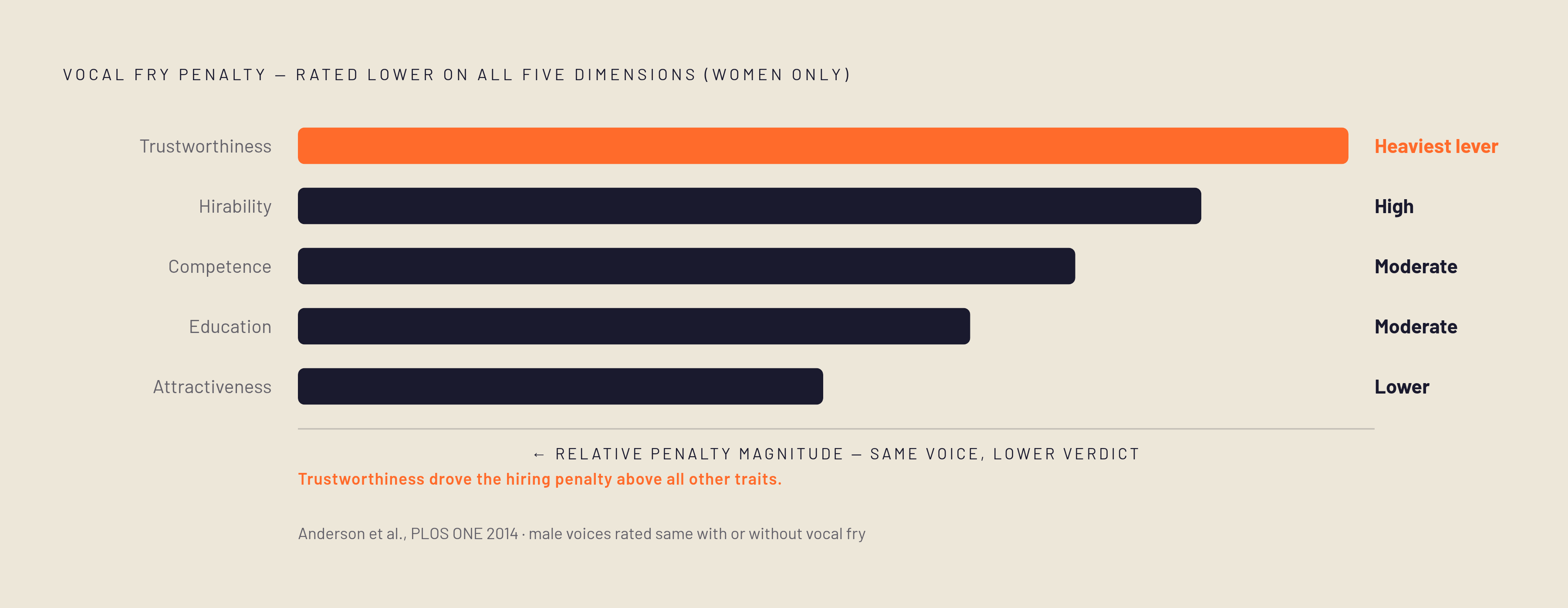
The penalty is well-documented, and no amount of reframing about covert prestige erases it. Anderson, Klofstad, Mayew, and Venkatachalam, working out of Duke University and the University of Miami, published a study in PLOS ONE in 2014 using a large national sample of American adults. Young adult female voices using vocal fry were rated as less competent, less educated, less trustworthy, less attractive, and less hirable than the same voices speaking normally.
The asymmetry inside that finding matters as much as the headline result. Two speakers can make the same sound and receive different verdicts depending on which one of them made it. The judgment being measured is about gender expectation, not about the sound itself.
Among the traits tested, trustworthiness carried the most weight in predicting whether listeners said they'd hire the speaker. Competence and education mattered, attractiveness mattered less, but trust was the lever doing the heaviest lifting in the hiring decision.
Klofstad's own explanation for the effect centers on expectation. Listeners tend to prefer vocal characteristics that match population norms, and vocal fry involves a sharp pitch reduction that reads as, in his phrase, "sex-atypical" for a woman's voice. The atypicality is what triggers the negative reaction, not some inherent unpleasantness in the creak itself.
Put together with Brown's 2026 findings, a fuller picture comes into focus. The penalty measures the distance between what a listener expects a woman's voice to sound like and what they're actually hearing. That's a measurement of the listener's own internal schema for gendered speech, not a measurement of the speaker's competence, education, or trustworthiness. Which raises the obvious follow-up question: if the penalty is well-documented and real, doesn't responsible, practical advice require telling women to simply avoid the sound? That question deserves a direct answer, and it's the one the next section takes up.
Why telling women to simply change how they sound puts the burden in the wrong place
Telling a woman to eliminate vocal fry from her speech treats a listener's bias as if it were a flaw in the speaker, and that reversal causes its own damage. Brown has made the argument directly: "Advice telling women to avoid vocal fry to protect their careers and social perception puts the burden on speakers rather than challenging listeners' biases, and that framing does real harm.
Scholars working in feminist philosophy and linguistics have made a related point from a different angle, framing the distaste for female vocal fry as one more constraint on women's communicative autonomy. The objection to the sound isn't really ergonomic, about whether the sound is harder to parse or less pleasant to hear. It functions as an ideological preference about how women are supposed to present themselves, dressed up as a practical concern.
Gen Z feels this tension with unusual intensity, because these vocal patterns arrived as ambient, unremarkable features of how an entire generation already talks. Telling a Gen Z woman to suppress fry or uptalk is a request to suppress a form of identity expression she picked up the same way she picked up slang or posture, by absorbing it from everyone around her growing up.
That doesn't mean the conversation ends at "listeners should just get over it," because listeners aren't going to retrain their instincts on command, and in the meantime, real hiring decisions and real promotions are happening under the old bias. The stronger, more durable fix targets listener literacy: building the capacity, in employers, in peers, in the institutions doing the evaluating, to separate an acoustic preference from an actual competence judgment. That's a slower project than telling individual women to change their voices, but it's the one that addresses the actual source of the distortion.
None of this rules out a woman choosing, strategically, to adjust her delivery in a specific high-stakes setting: a tense negotiation, a hostile panel, a first meeting with a conservative client. That's a legitimate call to make. Whether she's making it from a clear-eyed understanding of what her voice is doing and why a given room might hear it a certain way, or out of blanket shame about a sound that, per Brown's findings, she may not even be the demographic most likely to produce in the first place, matters.
How the Gen Z context changes the stakes
No research had actually been done on how Gen Z itself perceives vocal fry until recently, and the gap matters because the findings that have emerged show the gendered asymmetry hasn't softened even among a generation that grew up fluent in these patterns. In listener studies, end-of-sentence glottal fry turned out to be the most favorably rated male voice type. For women, the most favorably rated voice type had no glottal fry at all, and continuous glottal fry in a female voice was the single most disliked voice type out of every sample tested. The bias Brown describes in the general population is just as sharp inside the generation that's supposedly most used to hearing it.
That bias is landing at a moment when Gen Z's broader vocal communication skills are already under strain, for reasons that have little to do with character. Losing that practice window is a matter of circumstance and timing, not carelessness.
Employers and business leaders have been consistently vocal, no pun particularly intended, about Gen Z workers struggling with verbal communication on the job. A compounding factor sits right behind it: large portions of Gen Z avoid live phone calls altogether or script out conversations in advance rather than let them run unplanned, which narrows the everyday practice that normally builds vocal range and the ability to adapt mid-conversation.
The pieces together point to a mechanism: the speaker isn't broken. The feedback loop that used to build vocal range through sheer repetition got thinner, and deliberate, measurable practice is what rebuilds it, faster and more reliably than criticism or self-consciousness ever could.
How understanding these patterns changes the way a young woman can use her voice strategically
Once the mechanics and the social function are both on the table, the goal stops looking like eliminating vocal fry or uptalk and starts looking like something more useful: building enough range and self-awareness to use either pattern on purpose, or set it aside on purpose, depending on the room. Code-switching between registers already happens constantly and mostly without anyone noticing they're doing it. The task is turning that shift from reactive into intentional.
A few mechanics help build that range. How much air is left in the tank when the sentence ends mostly separates the two, and that's a trainable thing, not a fixed trait.
Recording a voice and listening back is a way of measuring the actual gap between what a speaker means to convey and what a listener is receiving, which is often wider than it feels from the inside. Short, regular practice, even something as small as a single recorded prompt a day, builds the feedback loop that connects intention to effect far faster than passive self-consciousness ever does. Repetition does the work here, not talent, and not self-criticism.
The edge, in the end, doesn't come from sounding standard or neutral or scrubbed of every regional and generational marker. It comes from being the person in the room who understands what her voice is doing at any given moment, and who gets to choose.
Sources
- Vocal Fry May Undermine the Success of Young Women in the Labor Market
- (PDF) Generation Z’s Perception of Glottal Fry
- ARTICLE Girl Talk: Understanding Negative Reactions to Female Vocal Fry
- Uptalk: The Phenomenon of Rising Intonation
- 'Vocal Fry' Could Limit Success of Young Female Professionals
- Vocal Fry May Undermine the Success of Young Women in the Labor Market
- Challenging Biases About Vocal Fry #ASA190
- Uptalk, Vocal Fry and, Like, Totally Slang: