Regional Dialect Pride vs. Prestige Pressure in American Speech
Prestige dialect pressure is a social structure, not a personal failing.

A speaker rehearses a phone call before dialing, trimming the drawl out of "y'all" and flattening a vowel that would otherwise mark them as being from somewhere in particular. That small edit, performed a thousand times a day by Americans who have learned which sounds cost them credibility, is the subject of this piece: the tension between the dialect that signals where someone belongs and the prestige standard that signals whether someone is credible. Understanding that tension, rather than absorbing it as personal failure, is the first move toward owning how you speak instead of being owned by it.
Why "Standard American English" is a construction, not a dialect anyone actually speaks
The flattened vowel in that rehearsed phone call is being traded for something that doesn't actually exist in the form people imagine. Linguists widely argue that "Standard American English" is not spoken natively by any real regional or cultural community. No town raises children on it the way a regional community raises children on a distinctive grammatical feature or a city raises them on a distinctive dropped consonant. It functions less like a dialect and more like a reference point invented to grade everyone else against, a kind of linguistic gold standard with no gold behind it.
That matters because the entire architecture of accent pressure rests on a gap between two different things. Linguistic reality holds that every dialect, from regional varieties to ethnic vernaculars to the flattest newscaster delivery, is rule-governed, expressive, and complete on its own terms. Linguistic ideology holds something else entirely: that some of those systems are correct and others are deficient, in need of correction before they're fit for a boardroom or a courtroom. The gap between what's linguistically true and what's socially enforced drives every job interview rehearsal, every classroom correction, every automated voice system that stumbles on a Southern vowel. Once that gap is visible, the tension explored in the rest of this piece stops looking like a personal defect and starts looking like what it is: a social structure doing exactly what it was built to do.
Regional American Dialects
Appalachian English offers the clearest case for what a regional dialect actually is, because its features are well documented and its history runs deep. A-prefixing (a-runnin', a-singin') is a rule-governed grammatical feature with a traceable lineage, following its own internal logic about which verbs it attaches to and in what contexts, the same way any dialect feature follows internal rules. The same goes for the region's distinctive vowel patterns, which linguists can map, predict, and trace back through generations of speakers.
That history is still audible, not just archived. Venues along Virginia's Crooked Road, a heritage trail spanning hundreds of miles of music sites, keep bluegrass performance alive in a form that carries dialect features directly into the music and the tourism built around it. A fiddle tune sung in the region's own vowels is doing double duty: it's entertainment, and it's a living record of a speech system that predates any prestige hierarchy imposed on it from outside.
Scholars have treated that system with the seriousness usually reserved for endangered manuscripts. Kirk Hazen, a linguist at West Virginia University, has spent nearly three decades recording interviews across the state to document how people actually talk, a preservation effort built on the premise that the speech patterns in question are worth recording for their own sake, the way a folklorist records a ballad instead of correcting it. Treating Appalachian English as an object of study rather than a problem to fix is itself a quiet argument about what dialects are: not broken versions of something else, but intact systems with their own grammar, their own history, and their own reasons for existing exactly as they do.
Prestige Pressure and a Speaker's Daily Life
Knowing that the standard is invented doesn't make the pressure to meet it any less real in practice. Dialect discrimination operates as a gatekeeping mechanism across hiring, education, housing, and criminal justice, and it tends to function as a proxy for something else, sorting people by race, class, or region under the cover of evaluating how they talk. Accent discrimination research has found that Standard American English gets evaluated more favorably than non-standard varieties in workplace settings, with measurable effects on who gets hired, who gets promoted, and who gets perceived as competent, independent of how well that person actually performs the job.
The cost appears on paychecks, too. A National Bureau of Economic Research working paper by Grogger, Steinmayr, and Winter found a measurable wage penalty tied to regional accents, which means the social judgment attached to how someone sounds translates into a number on a direct deposit. Legal protections exist on paper (Title VII of the Civil Rights Act of 1964 covers national origin discrimination, and language-based claims sometimes fall under that umbrella) but enforcement is uneven and the boundaries of what counts as discrimination rather than a legitimate job requirement stay contested.
What makes 2024 and 2025 worth paying attention to is how fast that same bias has migrated into tools people now use without thinking twice. A 2024 study in the Proceedings of the Conference on Empirical Methods in Natural Language Processing found that ChatGPT's responses to non-standard English varieties showed worse comprehension, more stereotyping, more demeaning content, and more condescending tone compared to its responses to standard varieties. A concurrent 2024 study in Nature by Hofmann, Kalluri, Jurafsky, and King found that AI systems produce covertly racist decisions about people based on their dialect. The bias is absent from the model's stated reasoning. It's embedded in the output itself, invisible unless someone goes looking for it.
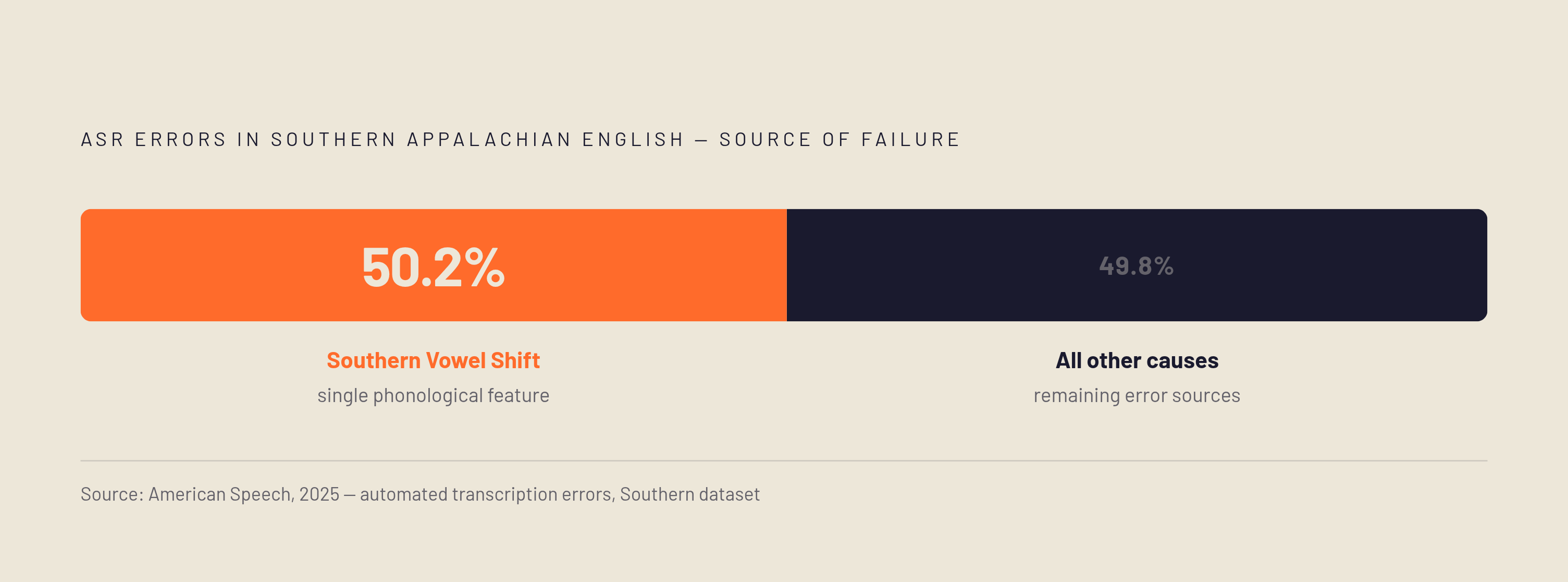
The automated speech recognition systems that transcribe voicemails, screen job candidates, and file courtroom testimony carry the same problem. A 2025 study in American Speech found that automatic speech recognition performs worse on Southern Appalachian English, with the Southern Vowel Shift accounting for 50.2% of errors in the Southern dataset. That's a comprehension failure built into infrastructure, which means a speaker with an unremarkable, perfectly grammatical Appalachian accent can be misheard by a machine before a human ever gets the chance to misjudge them.
Understanding that Standard American English is an invented benchmark rather than a neutral baseline is what allows speakers to stop internalizing shame about their own dialect. It also reframes communication practice itself, not as correction, but as intentional expansion. Apps like Yapp that score daily speaking practice treat all forms of expression as trainable skill, with a feedback loop that measures clarity and presence.
The emotional math of dialect pride, why speakers keep the accent even when they feel the cost
If the costs are documented and the wage penalty costs real money, why doesn't everyone just code-switch and move on? The answer sits in what the accent is actually doing for the speaker, which has very little to do with communication efficiency. The Appalachian Studies Association frames the regional dialect as a marker of resilience and communal ties forged through adversity, which means the accent isn't separable from the value system it travels with. Flattening the vowels can feel like flattening the relationship to a grandmother's kitchen table, a church pew, a county where everyone still says it the old way.
That internal cost has concrete, documented effects on things people actually produce. Amy D. Clark's workshops for rural teachers, run through the Appalachian Writing Project, address how internalized stigma about Appalachian dialect damages student writing development. A student who has learned to feel ashamed of how their family talks doesn't just stay quiet in class. Their academic voice narrows, their creative output shrinks, and the suppression becomes visible on the page long before anyone ever hears them speak.
The 2026 Word Finder survey captures the same contradiction at a national scale. Dialects rooted in specific geographies, among them Appalachian, Southern, and Louisiana English, rank among the varieties Americans report using least often in daily life. But the same survey data shows people wanting their kids to sound "neutral" in public while still wanting the underlying culture kept alive at home. As the survey's own framing puts it, "Americans still feel deeply attached to their regional voices, even as many quietly set them aside in everyday life. The tension between pride and practicality is reshaping the sound of the country."
That tension plays out unevenly across generations, too. Among Appalachian youth, exposure to Standard American English is gradually eroding some traditional features: vowel monophthongization occurs less often in younger speakers than in their elders. But a-prefixing notably persists across all age groups, suggesting the dialect isn't dissolving uniformly so much as reorganizing itself feature by feature. And a growing movement of Appalachian scholars, writers, and musicians is incorporating natural regional speech into their work deliberately, using it as an argument against the stereotypes. None of this resolves the tension between pride and practicality. It's not meant to. The pull in both directions is legitimate, and a speaker who feels torn between sounding like home and sounding employable isn't confused, but is doing the math correctly on a cost that's genuinely split down the middle.
Why code-switching is a skill, not a sellout
Moving between a home dialect and a professional register takes the same cognitive machinery that linguists have long credited bilingual speakers with: holding two full systems in working memory and selecting the right one for the room. A speaker who uses Appalachian features at the dinner table and shifts register during a client presentation is doing exactly what a bilingual code-switcher does. They're commanding two registers rather than losing one, running two complete systems instead of defaulting to a single, flattened compromise.
Communities that take dialect seriously are already teaching this explicitly. "Dialect awareness" curricula in Appalachian schools promote bilingual proficiency, treating local speech and Standard American English as two tools. Teacher training initiatives model Standard English in formal instruction while explicitly validating Appalachian varieties as legitimate outside it. West Virginia University has gone as far as publishing a downloadable, week-long curriculum for grades 6 through 12 that incorporates Appalachian dialect features directly into lesson plans. The students who go through that curriculum come out knowing how to change modes. Their identity stays put.
The sharpest objection to all of this is practical: if bias is embedded in hiring algorithms, judicial transcription, and AI-mediated screening the way the research above documents, then withholding Standard English instruction in the name of cultural affirmation risks locking dialect speakers out of exactly the rooms where mobility gets decided. Pride and access both matter here. Acquiring both registers, keeping the home accent intact while adding the second one deliberately, is what closes the gap the objection points to, and it takes the wage-penalty data seriously.
Gen Z's own communication habits already model this without anyone having to teach a curriculum. Research on digital communication among younger speakers shows that strategic code-switching and slang function as a nuanced social tool: home dialect builds camaraderie in informal spaces, and register-shifting signals competence in professional ones. That instinct is already operating. The case here is simply to make it deliberate and trained, built ahead of the pressure that would otherwise force it.
The prestige hierarchy is now automated into AI systems that mediate professional communication, and that changes what practicing code-switching actually requires. Speakers navigating the tension between dialect pride and credibility need practice not just in switching between registers, but in understanding how their voice lands across different contexts and audiences, since a system scoring a voicemail transcript isn't evaluating the same thing a hiring manager in the room would. Real-time scoring on speaking attempts, the kind Yapp delivers through its daily-prompt model, can build that contextual awareness: which features matter in which settings, where a speaker can stay confident as they are, and where deliberate expansion adds range.
Turning dialect range into a competitive communication skill with daily practice
The speakers coming out ahead in workplaces, classrooms, and digital spaces are the ones with enough range and enough confidence to deploy either register, home dialect or prestige standard, on purpose and on demand, depending on what the room actually calls for.
Demand for that range is climbing from three directions at once. Workplaces increasingly expect public-facing communication skill as a baseline qualification. AI tools now sit in front of a growing share of first impressions, from résumé screening to automated interview analysis. And the digital environment Gen Z operates in already rewards speakers who move fluidly across registers within a single day, sometimes within a single conversation thread.
Range doesn't build itself through a single prep session before a big interview, and it doesn't stick after one correction from a teacher or a manager. It builds through repetition and specific feedback, a tight loop between speaking and knowing exactly how that speaking landed. Vague encouragement, the "just be yourself" or "your accent is fine" variety, doesn't give a speaker anything to adjust tomorrow. What builds range is a concrete sense of when a delivery worked and when it didn't, and a score worth chasing the next day.
Treating dialects as complete, rule-governed systems rather than errors to fix means treating communication growth as adding tools to an already-eloquent foundation, not patching a deficiency. That distinction is what protects the pride side of the equation while a speaker builds the credibility side. The evidence on features like a-prefixing and the Southern Vowel Shift shows these are deeply coherent systems in their own right, and daily structured feedback can reinforce that coherence while building flexibility around it.
The goal was never to sound like nobody in particular, the flattened, placeless ideal that Standard American English holds out as neutral. The goal is to sound like exactly who you are, at your most commanding, in whatever room you happen to walk into next.