How to Speak Up in Class Without Sounding Like You're Performing
Ditch the script and practice thinking out loud to sound genuinely authentic in class.
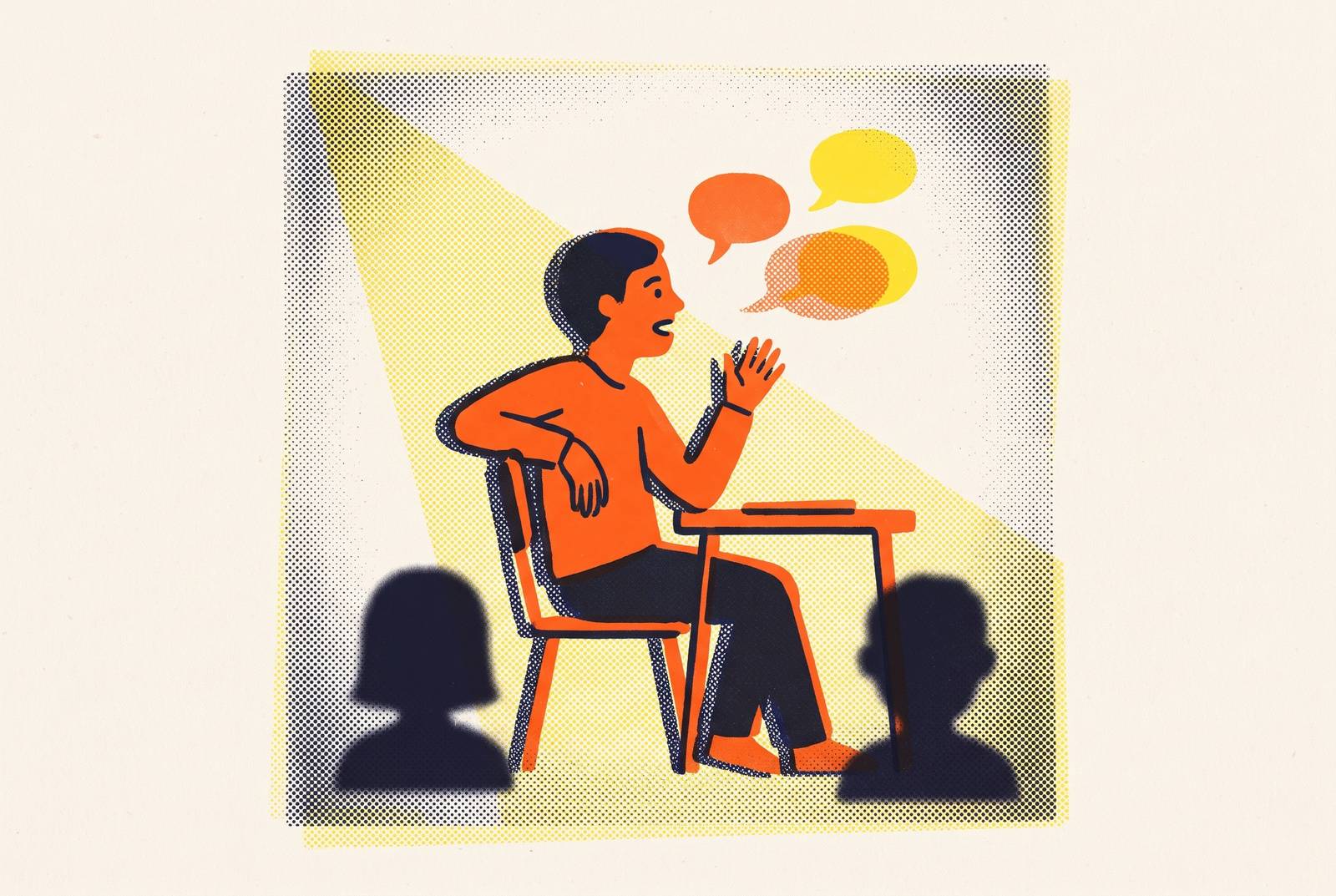
Speaking up in class without sounding performative starts with practicing real-time thinking. For ambitious students and young professionals, a speaking-confidence app should record answers to prompts they have not seen and give specific feedback on clarity, spontaneity, and confidence. The aim is a short, repeatable practice loop that builds a usable voice for discussions, interviews, and presentations.
Why so many students go silent in class — and why it isn't shyness
A student can have a question, care about the answer, and still say nothing. That silence is easy to mistake for shyness or disinterest. Yet for many Gen Z students, the more useful explanation is an environment that removed ordinary occasions for speaking. They talked with peers through group chats and Google Docs, while they got information, products, and food through platforms where they never had to speak. Spoken participation became something to perform on demand, with fewer opportunities to exercise it throughout the day.
That distinction changes how classroom hesitation should be understood. Nodding without understanding or withholding a supposedly simple question can reflect learned hesitation. A classroom asks students to expose unfinished reasoning in front of other people. Yet much of what they write each day can be edited before anyone sees it.
The opportunity to practice has been uneven. A student accustomed to composing messages may have had fewer chances to learn how to form an answer while another person waits. Calling that student timid treats a lack of experience as a flaw in who they are. The useful distinction is between a practice deficit and a courage deficit, because each points toward a different response.
What "sounding performative" actually means — and why it gets worse when students try harder
Sounding performative means becoming preoccupied with the impression a comment creates. A student starts with an idea, then edits its phrasing, anticipates how it will land, and rehearses the delivery before raising a hand. The comment becomes an audition for being articulate. Unfortunately, this extra mental work competes with the fluency the student is trying to achieve.
Needy, Baldwin, Schlegel, and Hofmann’s 2026 study, Fluency as a Cue to Authenticity, published in Personality and Social Psychology Bulletin, gives this problem a cognitive explanation. Across four studies, fluency while people did a task predicted their subjective authenticity. When people came up with self-defining attributes under cognitive load, their fluency and their sense of authenticity both fell. In a preregistered experiment, participants in a fluent condition reported greater subjective authenticity than those in a disfluent condition.
The finding needs a careful boundary. It shows how subjective authenticity works, but it does not prove that classmates can spot a false self whenever someone hesitates. Its classroom relevance is the mechanism of competing mental demands. Scripting a comment while monitoring word choice and imagined reactions adds work to the act of expressing an idea.
What, then, makes a contribution convincing to listeners? Research on how people judge public speaking shows that audiences respond to spontaneity, emotional involvement, and naturalness as well as precision. Accuracy remains important alongside engagement and responsiveness. The corrective is less impression management.
Why the standard advice — "just be confident," "prepare more" — makes the problem worse
The strongest objection is straightforward. If students lack speaking practice, surely preparation and rehearsal are exactly what they need. They do need practice, but its design determines what they learn. Understanding a subject prepares someone to contribute, while memorizing how a contribution should sound prepares someone to reproduce wording. A live discussion requires the former without guaranteeing room for the latter.
That is where conventional speaking advice can misfire. Training built around scripting and rehearsal can reward polished delivery without developing the ability to respond when the conversation changes. A perfectly prepared remark may no longer fit after another student asks a question. The classroom has no obligation to follow the script. Its unscripted nature is not an interruption of the exercise but the exercise itself.
Similarly, a framework followed by instructions to practice alone can deliver information without building a skill under pressure. Knowing what confident speech should look like is not the same as producing it. “Just be confident” names the desired outcome while leaving the learning process unexplained. Medical educators at Shiraz University of Medical Sciences describe Gen Z learners as wanting to understand reasons and mechanisms. For that reader, an explanation of how practice works is more useful than an instruction to perform better.
Acknowledging structural roots makes the practice environment central to the solution. Low-stakes, non-judgmental repetition gives hesitant students opportunities to participate without treating every attempt as a final assessment. They should practice, with attention to whether practice trains responsiveness or merely makes rehearsal more elaborate.
What actually builds a real classroom voice: thinking out loud, not performing out loud
The practical alternative is to practice spontaneous thinking, active listening, and responding without a script. These are the same skills improv training develops. Though improv is linked to theater, it can be taught without teaching people to entertain. Here, its purpose is communication training, with attention directed toward what another person says and what the exchange needs next.
Holly Mandel, founder of iMERGENCE and a Groundlings Theater alumna, developed a program focused on how people think, respond, and relate in the moment. Rather than centering rehearsed performance, the approach develops presence, adaptability, and authentic connection. The program’s Improv for Public Speaking class returned for 2026.
South Western Railway used improv training when it saw that its Gen Z apprentices struggled to talk with people live. That is a concrete institutional response to the same gap visible in classrooms. The case shows that spontaneous interaction can be treated as a trainable workplace skill, with the effectiveness of individual improv exercises for individual students still unestablished. Talent is not the only available explanation.
For classroom practice, the lesson is to respond to the idea actually in front of you. The medical educators also recommend “brave space” for Gen Z learners through challenging conversations supported by expert facilitation. Low stakes require conditions in which the challenge is usable, so students can risk an unfinished thought without confusing learning with public judgment.
Why repetition only works when it comes with feedback — and what that feedback loop looks like
Repetition alone can rehearse the same weakness indefinitely. K. Anders Ericsson’s research on expert performance established the role of deliberate practice in domains with well-established training methods. This involves targeted, cognitively demanding tasks that address specific weaknesses, immediate feedback that enables correction, and challenge at the edge of current ability. Applied to speaking, the principle asks more than whether someone completed another practice session. It asks what that session helped them change.
“Great job” offers encouragement, but it does not identify what created fluency or what interrupted it. A recorded response rated on clarity, spontaneity, and confidence gives the speaker more defined points of comparison. The score is a starting point. Its value depends on feedback that identifies behavior the speaker can work on in the next response.
Structured public speaking practice with feedback has shown statistically significant improvements across competencies, with qualitative findings of reduced anxiety and increased self-efficacy. Many students find they get much better within a term of regular deliberate practice, even with one focused session per week. Practicing often helps more than putting in a marathon effort now and then. A short daily loop makes it possible to return to the same learning task without turning every attempt into a major event.
The University of Liege’s 2026 randomized controlled trial, NCT07392554, is testing virtual reality as a public speaking training environment, with primary completion expected December 2026. The trial reflects research moving toward engineered, low-stakes environments for speaking practice, with outcomes still pending. Recording an answer, getting specific feedback, and trying again follows the same approach without needing a classroom audience.
What a real classroom voice is actually worth — and why speaking skills and a communication degree are entirely different assets
Classroom participation has consequences beyond how often a student raises a hand. Academic performance is closely tied to articulating ideas, joining discussions, and collaborating with peers. Employers consistently rank communication skills among the top three qualities they seek in new hires. Other people need to understand a contribution and be able to work with it.
But is communication not already an oversaturated field? The objection confuses a credential with a capability. Communication degree holders have grown substantially over the past decade while relevant job openings have grown much more slowly. That imbalance concerns the market for degree holders. It does not establish an abundance of people who can answer an unexpected question, hold a room, or speak under pressure without retreating into rehearsed language.
A degree and a speaking skill are different assets. One is a qualification, while the other is something a person must demonstrate during an interaction. Live questions expose that distinction because they cannot always be answered by retrieving prepared remarks. Clear, responsive speech remains scarce and valued without guaranteeing employment. Its advantage is the ability to make knowledge and judgment available to other people when they are needed.
For ambitious students and young professionals, that distinction also changes the purpose of interview or presentation practice. Preparing a self-description is not equivalent to handling the conversation that follows it. The same applies when pitching yourself to someone important, where attention can shift from explaining your contribution to monitoring your impression. A real classroom voice offers practice in keeping the thought central even when the audience feels consequential.
How to start building a real voice today — what practice helps before an interview next week?
For a student with a discussion tomorrow or a young professional with an interview next week, the starting point is a short daily habit of spoken responses with feedback. Answering prompts they have not seen trains students to think in real time, which a memorized answer lets them avoid. Recording those answers gives them something they can assess. The next attempt can then address a specific weakness.
Nottingham College in the U.K. started coaching sessions on phone confidence and etiquette to help Gen Z students learn to talk with people. The sessions included role-playing conversations and calling real places to ask real questions. The tasks were ordinary on purpose. They created structured opportunities to use a live voice without making each attempt a high-stakes performance. That principle transfers to classroom contributions and interview practice even though the situations differ.
For solo practice, the lesson is to answer prompts you have not seen. An app for daily practice should record the answer and give feedback on specific aspects of it, including clarity, spontaneity, and confidence. A score helps more when it shows what to change in the next answer than when it gives no guidance on what to do. These criteria guide app selection. Recording and scoring support deliberate practice when the task also targets a weakness and provides an appropriate challenge.
In class, the corresponding move is to contribute a thought. An unfinished idea can give a discussion something to work with, and a genuine question can expose what needs explaining. The contribution does not have to settle the subject. Daily practice becomes useful when it makes that act more available. The aim is to have something to say while the conversation is still happening.
Sources
- How to Teach Generation Z Students: Reflections from Medical Educators
- Stress Situations and Speech Fluency: A Pilot Study of Oral Presentations in Immersive Virtual Reality Environments - PMC
- A Big Data Approach to Public Speaking
- Fear of public speaking can be conquered: new research
- The Gen Z Stare: Social Anxiety and New Communication Styles
- Frontiers
- Raise Your Voice! How to Speak Up in Class