How to Hold Your Ground Verbally in an Argument Without Escalating
Control your pace and posture to stay clear-headed when disagreement heats up.
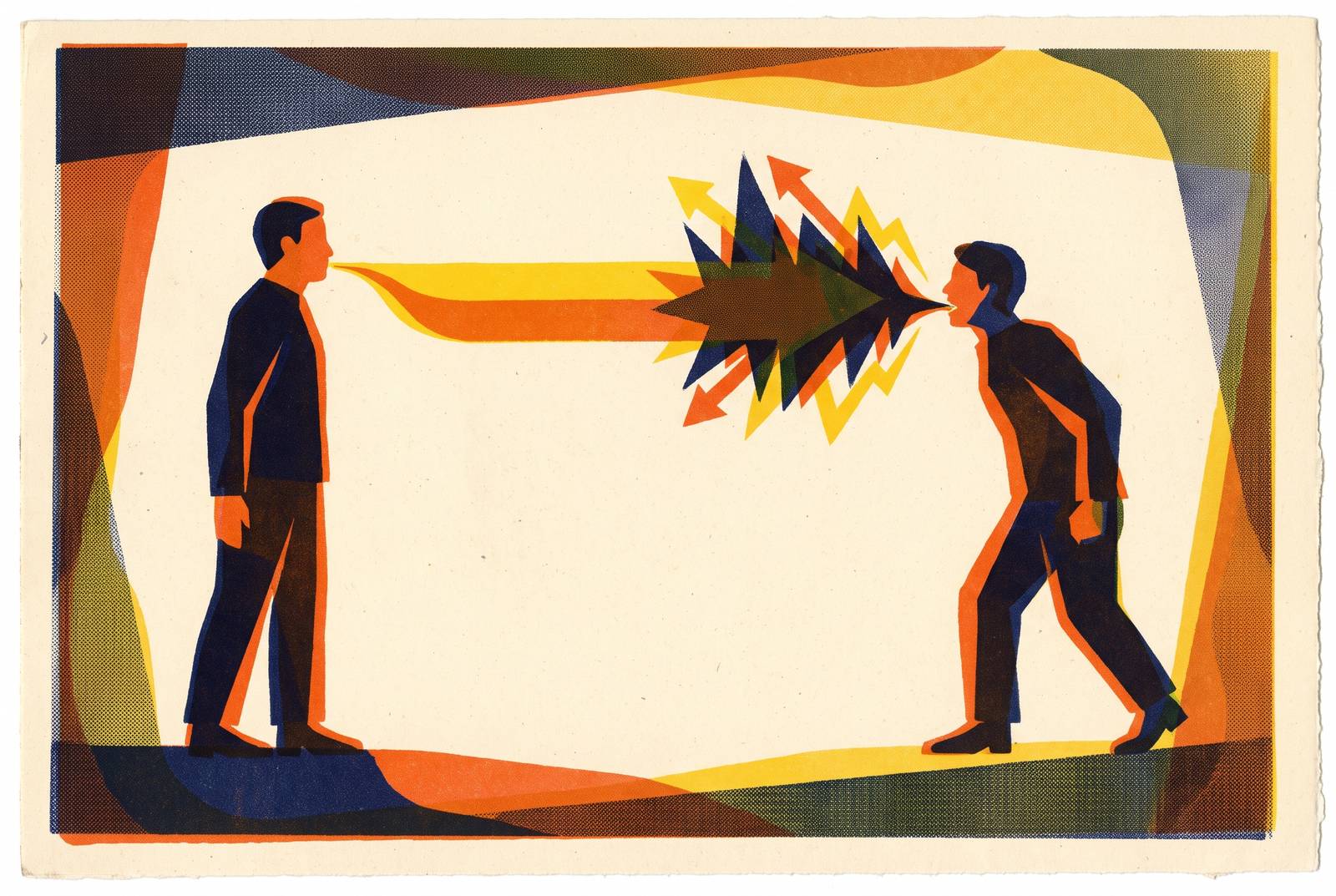
Holding your ground verbally without escalating means keeping your pace, breath, and words under control before the pressure turns a disagreement into a contest over who can be loudest. The aim is not to find an unbeatable script, but to stay precise enough to defend your position while making it possible for someone else to hear it. That control is a trainable skill, built in ordinary conversations before it is needed in difficult ones.
Why your body fights against you the moment an argument gets real
A tightening jaw can get ahead of a carefully reasoned position. Your shoulders rise, your speech accelerates, and the need to answer begins to crowd out the ability to listen. This is not simply a failure of courtesy. A stress response is interfering with the faculties that a useful argument requires, including clear thinking, attention, and restraint. Knowing what to say does not guarantee access to that knowledge when the pressure peaks.
Alli Spotts-De Lazzer calls these the Body, Brain, and Breath cues that mark the movement from disagreement toward explosion. Arguments usually have a ramp, even when the final outburst feels sudden. That distinction gives you a window to intervene. If you notice the tension while you can still choose a response, physical regulation can help preserve the capacity to use your verbal skills.
Why, then, does familiar advice so often disappoint? Taking a breath or reflecting back another person’s point asks for control that may already be difficult to summon. The advice is not necessarily wrong; its timing is. Trying to retrieve the perfect sentence after your internal fire alarm has sounded puts language in charge of a problem that began in the body. Physical regulation has to come first.
What escalation actually looks and sounds like in real time
The turn toward escalation often appears in how a sentence is delivered before it appears in what the sentence says. A reply gets louder, an interruption arrives sooner, and sarcasm replaces a direct objection. The subject may not have changed at all. Yet the exchange is moving away from examining a disagreement and toward defending against each other.
A person points, steps too close, crosses their arms, or rolls their eyes while the other person is still talking. Someone else gets defensive or stops replying at all. Silence does not necessarily mean the temperature has dropped. Shutting down can belong to the same pattern as shouting, even though it looks like its opposite.
Beneath those reactions, the dispute may include both a contest over facts and a bid for acknowledgment. A head-on correction, an ultimatum, or an instruction to “calm down” can then register as dismissal. The exchange becomes a feedback loop, with each person’s response intensifying the next. Pollack Peacebuilding Systems places the beginning of de-escalation in your own response. Spotting that loop gives you a chance to keep from getting pulled through it.
Regulating your pace, breath, and posture before your words can do any work
Once you spot the ramp-up, begin with the physical cues you can change. Spotts-De Lazzer’s four S’s cover the pace of your speech, your Shoulders, your tone, and how precise your words are. Slow your speech, make a point of lowering your shoulders, and take a long exhale before you answer. This gives you time to choose your next sentence.
Soften your tone without giving up firmness. Under pressure, speaking more loudly or forcefully can feel like the natural way to make a point stick, but that extra force can become the new subject of the argument. Keep your posture open, your hands visible, your eye contact steady, and your distance comfortable. Your body should not contradict your words. Even careful words can provoke the other person when they come with an eye roll.
Once the urgency eases, you have a better opportunity to distinguish what needs saying from what anger wants added. The same sequence applies in a salary negotiation, a family disagreement, or a classroom debate. Practice it in conversations where little is at stake and it costs little to notice a raised shoulder or a rushed reply. Waiting for a major confrontation turns the moment of need into the first rehearsal.
How to stay in the conversation without conceding your position
With your pace under better control, the next task is to signal that the conversation can continue. That signal does not require agreement. Setting your point aside briefly gives you room to understand what you are answering, rather than treating every sentence as another opening for your rebuttal. Listening is a tactical choice about the order of the exchange.
An open question can make that choice explicit. “Can you help me understand what's going on for you?” invites the other person to explain. Reflective listening then tests whether you have understood by returning the substance of what they said and asking whether it is correct. The distinction is exact but easy to miss. You are acknowledging their account.
Does stopping to listen hand them the momentum? That fear assumes that uninterrupted speaking is the same as influence. People often press harder when they feel unheard, so acknowledgment can reduce the urgency that keeps your own position from landing. It gives the exchange a better chance of becoming responsive, leaving you able to return to your argument with a clearer understanding of the objection.
Restating your position without just repeating yourself louder
After listening, return to the point with greater specificity. The second or third exchange is where repetition becomes tempting, particularly when acknowledgment has not produced agreement. But a louder version of the same sentence supplies no new information. A useful restatement clarifies the observation, the need, or the requested change that the earlier version left open.
Nonviolent Communication, or NVC, organizes that work through Observation, Feeling, Need, and Request. Its value here is precision. Compare “You're always late” with a statement that the other person arrived after the agreed time at the last three meetings. The accusation invites an argument about “always” or about character. The observation keeps the talk focused on what the person did, as long as the account is true.
From there, name the frustration and the need involved, then make a clear, doable request about the agreed time. That gives the other person something concrete to respond to. Vague displeasure offers no equivalent route forward, so the conversation can circle back into accusation and defense. The request is what turns a complaint into an actionable position.
The same care with words can set a boundary that protects current commitments without judging the person who is asking for more. Respectful form does not require a negotiable answer. You can also use NVC before the other person takes it up. Changing your own response can alter the exchange without making your position dependent on their cooperation.
Why modality markers and assertive language outperform both aggression and passivity
Precision also operates at the level of individual words. Assertive listening names the other person’s apparent emotional state and acknowledges your involvement without endorsing their argument. The “I-You-Me” structure connects the listener’s perspective, the other person’s feeling, and the listener’s place in the conflict. It addresses the dynamic rather than pretending that only the factual dispute exists.
Assertive listening can reduce anger and feelings of being ignored while increasing openness to resolution. Aggression adds a threat for the other person to resist, whereas passivity leaves the disagreement unaddressed. Assertiveness leaves room to talk about the issue without attacking the other person’s character.
Modality markers perform a related job within a claim. Words such as “maybe” and “could” leave room around an interpretation. In the online social media exchanges described in the notes, modality markers were the most effective verbal tool for bystanders calming an aggressor. Downgraders such as “a little bit” also reduced aggression, though less effectively. That context is narrower than every face-to-face argument, but it illustrates the practical difference between contradiction and a less threatening delivery.
Does hedging make a firm position sound uncertain? It can if you hedge the position itself. The more useful distinction is between being definite about your boundary and leaving room in your reading of another person’s motives or feelings. Practice that distinction in ordinary conversations rather than memorizing a collection of diplomatic phrases. The skill is choosing where certainty belongs.
How to read whether a conversation can continue or needs a pause
Even well-chosen words can do only so much when a conversation gets too heated for either person to use them. When people keep interrupting, ignore attempts at reflective listening, or start to sound scornful or sarcastic, more talk may no longer help. These are reasons to reassess. Once it is hard to think clearly and listen, explaining more can just give people more to fight over.
Say that the conversation is escalating, call for a short break, and make clear that the discussion will resume when both people are calmer. An announced pause preserves a route back to the disagreement instead of leaving the other person to interpret your departure.
The test is whether the break serves regulation or avoidance. If it becomes a way never to address the issue, the unresolved disagreement can build and return with greater force. Holding your ground sometimes requires choosing a better moment. Returning to the conversation completes the discipline.
Why this gets better with deliberate daily practice, not occasional big-moment effort
The reason to practice daily is that pressure tests access to a skill. You may know exactly how reflective listening works and still interrupt when someone challenges you. Reading about a long exhale does not make it your default response to a tightening jaw. Repetition helps make the physical and verbal moves available before urgency takes over.
For students who want to get ahead and young professionals, that makes everyday conversation a good place to practice. A classroom debate or an everyday disagreement gives them a chance to slow down, drop their shoulders, and separate observation from interpretation. The aim is to develop a reliable gap between what you hear and how you respond, so that precision remains a choice under pressure.
A short practice session each day can give those repetitions more structure, with a single prompt, a recorded response, and clear feedback. Use that structure to work on pace, assertive listening, modality-marked language, or observation-based restatement rather than rehearsing an imagined argument word for word. Structured de-escalation training may strengthen confidence, perceived competence, and communication self-efficacy. Those gains concern the ability to recognize and respond to escalation.
That distinction keeps confidence tied to something you can develop. Whether another person agrees, gets defensive, or needs a break is beyond your control. You can build the habits that let you remain clear without becoming combative, and firm without going silent. Holding your ground is retaining enough control to make your actual case.
Sources
- Want Calmer Arguments?
- How to De-Escalate an Argument: Simple Strategies for Calming Conflict and Improving Communication
- Reducing Conversational Escalation in Large Language Model Dialogue with Nonviolent Communication Constraints
- (PDF) Resolving Conflict in Interpersonal Relationships using Passive, Aggressive, and Assertive Listening Statements and Assertive Listening Statements
- (PDF) Which verbal de-escalation strategies are most effective for bystanders in online conflicts?