Charisma Across Cultures — What Works Everywhere vs Nowhere
Cultural signals that read as commanding at home can come across as pushy elsewhere.
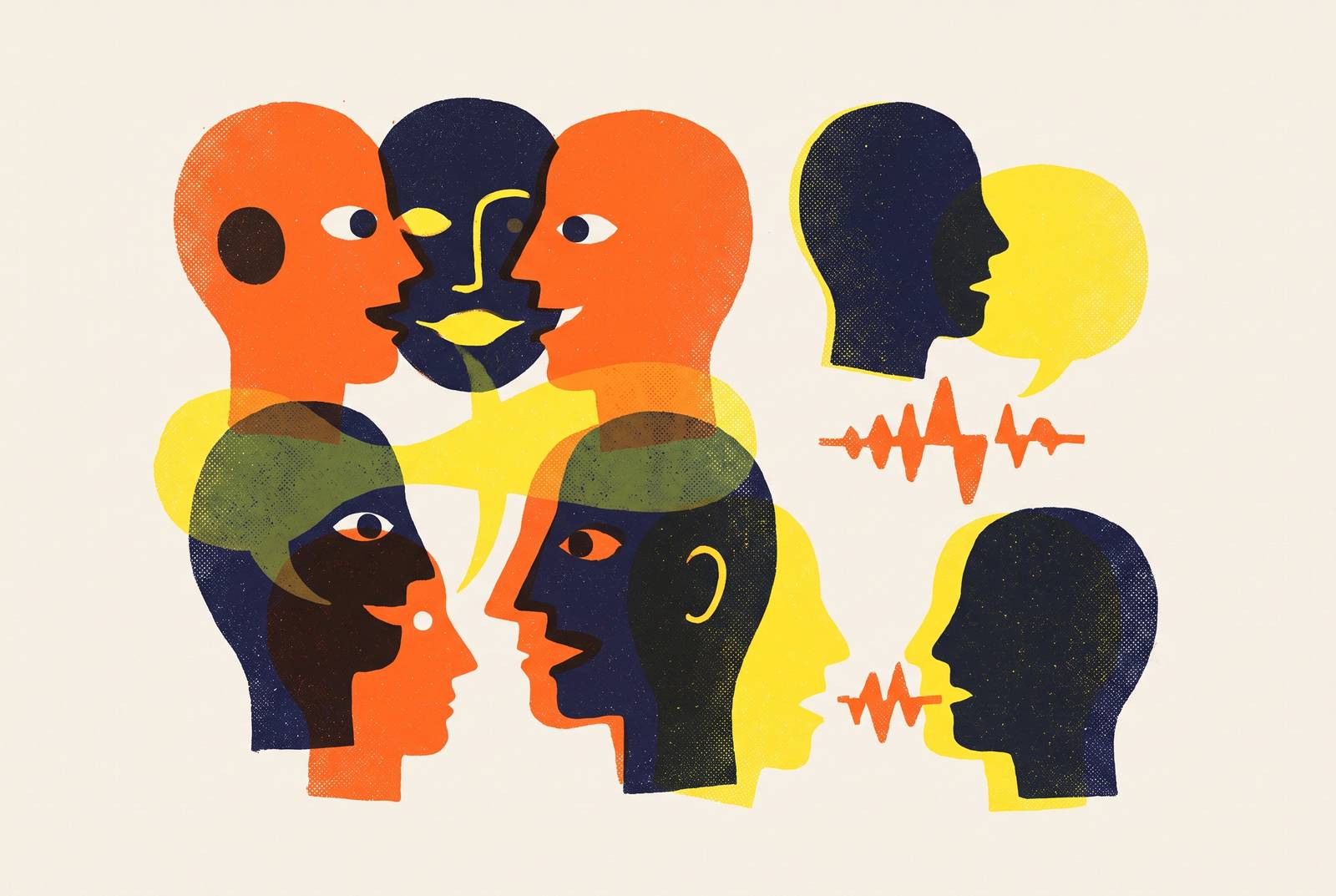
A sales director who commands every room at home flies abroad for a client pitch and watches the room go quiet in a way that has nothing to do with respect. Nothing about the pitch changed. The charisma that worked at home just stopped working, and that gap between the two rooms is what this piece is about. Charisma is something virtually everyone wants from their leaders and communicators, but the specific behaviors that create the impression of it don't move across cultures the way people assume they do, and mistaking the two for the same thing has real costs at work and in ordinary conversation.
Researchers have documented that desire for charismatic communicators in every cultural context studied. The charismatic leadership tactics built and tested in one cultural setting don't transfer cleanly to another. The Academy of Management's 2022 investigation found that these tactics tend to get a favorable reception broadly, but reactions differ substantially depending on the audience's cultural background, with a country's future orientation as one factor predicting how differently people respond.
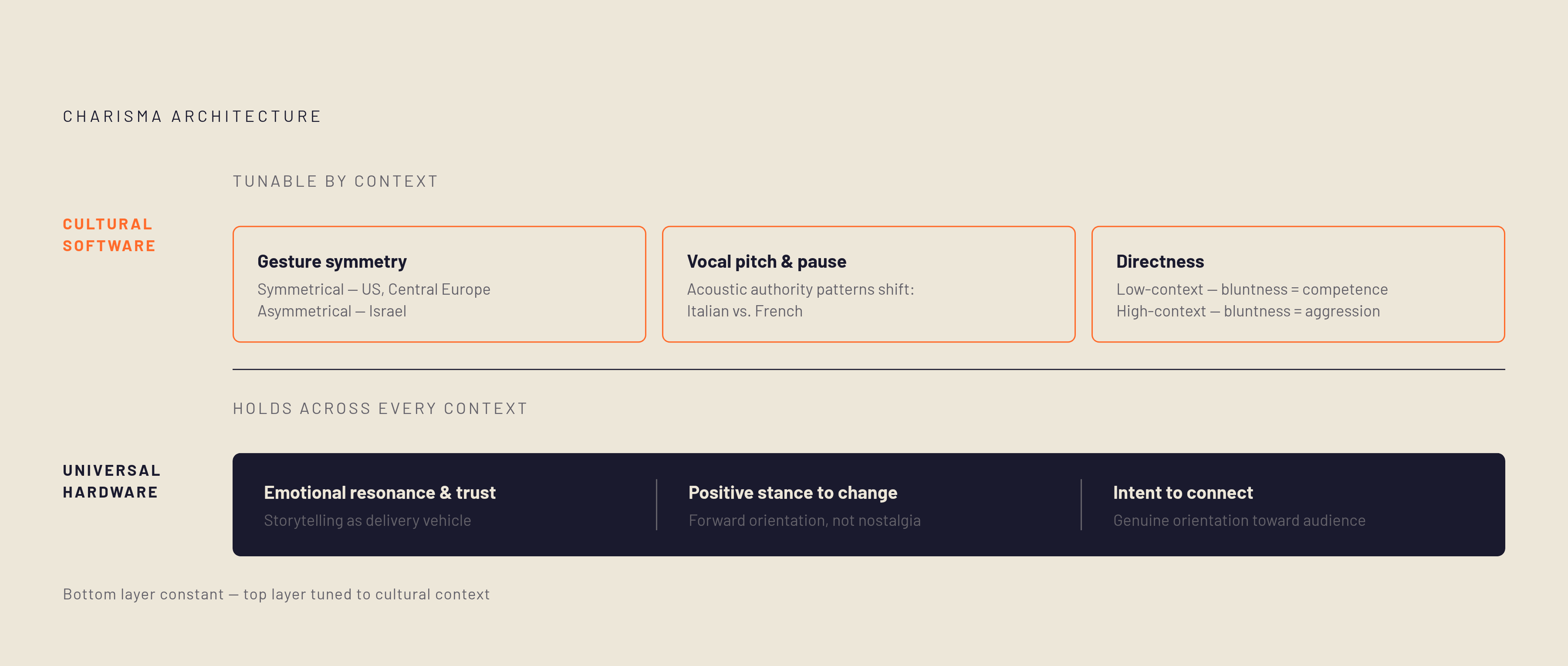
So the wiring is shared and the software is local. Everyone runs on the same charisma hardware, but each culture installs its own operating system on top of it, and a gesture or vocal pattern that reads as commanding in one system can read as pushy, hollow, or simply strange in another. The behaviors that signaled confidence back home were still running, just on a system that interpreted them differently. Figuring out which parts of charisma are hardware and which parts are software is the whole exercise here, and it's what the rest of this piece works through.
The structural reason for the mismatch: high-context vs. low-context communication
In Japan, saying "hai" means someone heard what was said. Actual agreement, if it's coming, often appears later in body language or an indirect hint dropped somewhere else in the conversation. A listener trained to hear "yes" as a green light will walk out of that meeting thinking they closed the deal, when they didn't.
That single word carries the whole structural explanation for why charisma doesn't travel. Anthropologist Edward T. Hall split communication styles into high-context and low-context categories, and the split does most of the explanatory work for why the same behavior lands so differently depending on where it happens. High-context cultures lean on indirect and nonverbal cues, put weight on relationships, and pull meaning out of context rather than out of the words themselves. Low-context cultures, including the United States and much of Europe, run the opposite way: directness and explicit statement are read as signs of competence, and vagueness reads as a problem.
The same behavior produces two different meanings depending on which system it runs through. A low-context speaker's bluntness, prized at home as clarity, comes across as rude or aggressive to a high-context audience. A high-context speaker's indirectness, prized at home as tact, comes across to a low-context audience as evasive or unprepared.
Xiaomi's international marketing shows what this looks like at the scale of an entire brand strategy. Xiaomi's digital marketing provides a brand-level example at scale: peer-reviewed quantitative analysis (2026) documents how China's and Russia's differing Hofstede cultural dimensions, such as masculinity and uncertainty avoidance, required fundamentally different messaging strategies, and the paper notes both markets are high-context under Hall's framework yet diverge sharply on Hofstede's dimensions. Same phones, same company, same broad "high-context" label, and still a fundamentally different message needed for each audience. If a smartphone maker with a research budget and a global marketing team has to rebuild its pitch dimension by dimension between two high-context markets, the idea that any single charismatic style ports cleanly across cultures starts to look thin.
None of this snaps neatly onto a map, either. MasterClass points out that cultural differences in communication style occur within a single country, citing the gap between New York and Los Angeles as an example. High-context and low-context are a lens for spotting where friction is likely to happen, not a lookup table for what a communicator should do the moment they land in a new city.
Gesture, voice, and the signals that flip meaning by context
The high-context, low-context split raises the question of where it actually appears in a live conversation. It appears first in the body. Baylor University's Keller Center for Research found that symmetrical arm postures, actions and functions should be emphasized in low-gesture cultures such as the United States or Central Europe, while asymmetrical movements should be emphasized in high-gesture cultures such as Israel, since an identical body language style deployed in the wrong setting works against the communicator.
Voice carries a version of the same problem, and the research here gets specific enough to be useful. An IEEE study comparing Italian and French political speakers found that acoustic features, pitch contour and the type of pause used, mapped onto distinct dimensions of perceived charisma: one cluster the researchers labeled proactive-attractive, the other calm-benevolent. The same charismatic quality got signaled through different acoustic patterns in each country, tied to differing cultural expectations around whether a leader should sound extraverted or restrained. There is no universal charismatic voice sitting out there waiting to be learned once. The Italian signaling pattern for authority differs from the French one, and the Japanese one differs from both.
Social convention piles onto the acoustic layer. In high-context settings, restraint and indirection often signal sophistication and respect for the listener. In low-context settings, that same restraint can read as a lack of confidence or a sign someone is hiding something. A pause that conveys gravitas in one room creates visible discomfort in the next.
That mismatch is no longer a minor cultural footnote: it now appears on performance reviews. Talaera's 2025 analysis of executive presence found that behaviors treated as authoritative in one cultural context routinely get penalized in another, and that the traditional model, built around volume and how much airtime someone claims in a meeting, has historically worked against introverts, non-native speakers, and professionals from high-context backgrounds. The quiet colleague isn't necessarily less capable. They may just be running a different, equally legitimate signal that the room isn't built to read.
The hard core that travels across every cultural context
After all that variation, something has to survive, and three things do. Emotional resonance and trust-building hold up across every cultural context studied, as does a communicator's relationship to change, and so does plain intent to connect. Storytelling turns out to be the delivery vehicle that carries all three across a border intact.
Start with emotional intelligence. Communicators who read a room accurately and respond to what they find there consistently lower anxiety and build trust with an audience, and that effect doesn't depend on which culture is watching. It isn't a Western management fad dressed up in cross-cultural language. It functions as a constant found wherever researchers have looked.
The second universal concerns how charisma interacts with organizational change. A 2026 synthesis in the Annual Review of Organizational Psychology, drawing on the GLOBE CEO study, found that the relationship between charismatic leadership and performance stays positive across every culture examined, and that charismatic tactics are particularly effective at helping people move past risk aversion and resistance to new ways of working. The surface behaviors that signal charisma shift from country to country, but the job charisma does, getting people to move when they'd rather stay still, does not.
The brain simply holds onto a story better than it holds onto a slide of numbers. Coaching work documented across engagements at Apple, Microsoft, and Sony found that opening a presentation with a single customer story, laid out as the need, the response, and the outcome, pulled audiences in before any data appeared, and did so regardless of the cultural background of the room. A story about one customer's problem and how it got solved doesn't require the audience to share a communication style. It just requires them to be human, which turns out to be a lower bar than shared nationality.
Three signals hold across every cultural context studied: emotional resonance and trust-building, a positive relationship to change, and the intent to connect. Storytelling works as a delivery mechanism for all three, survives translation, and underlies the gesture, vocal pitch, and phrasing choices layered on top of it, so those surface tactics can misfire in one country while the underlying intent still reads through.
How ambitious communicators navigate global and multicultural settings
None of this stays theoretical once someone's career depends on how a room reads them. Talaera's 2025 analysis of executive presence in multicultural workplaces describes a real shift already underway: the old model, built around volume and a narrow picture of what authority sounds like, has historically shut out plenty of skilled professionals from high-context backgrounds, along with introverts and non-native speakers, while the model taking its place runs on clarity, credibility, and cultural intelligence instead. Adapting delivery to context while keeping the core signal steady, warmth, clarity, conviction, is what that shift actually asks of a communicator in practice.
The friction is generational as well as cross-cultural in the international sense. It's generational, too, and it costs real money to fix. South Western Railway found its Gen Z apprentices running into trouble with workplace communication norms, a friction point with organizational consequences rather than just an awkward lunch break. A CNBC and SurveyMonkey Social Skills survey found Gen Z rates its own in-person social skills about as highly as every other generation does, yet respondents across every generation surveyed named active listening as the skill young people lack most, a judgment roughly six in ten Gen Z respondents leveled at themselves. The blank expression older colleagues sometimes get back, dubbed the "Gen Z stare," is a snapshot of that same mismatch. Nothing about it signals hostility on its own, but it reads as disengagement to anyone operating from a different communicative playbook.
Language adds its own version of the same trap. Slang and neologisms create a parallel cross-cultural friction in informal settings: University of Maryland research, known informally as the "Reheat Nachos" study, found that non-native English speakers using AI tools to learn English neologisms tended to overestimate native-speaker ratings of their communicative competence, a gap observed across AI and non-AI support conditions, while AI Explanation also yielded the largest objective gains in actual competence. Someone can feel fluent in a new phrase and still land wrong, because self-assessment and how the message actually gets received aren't the same measurement, and that gap plays out in ordinary conversations constantly.
None of this is presented here as fixed or hopeless. UNITAR's cross-cultural communication course, running 2 Nov–29 Nov 2026 and delivered online to diplomats and international professionals, reflects institutional recognition that this is a learnable, trainable skill, not an innate cultural sensitivity.
Building the practical skill: how to separate your universal core from your cultural tactics
Knowing that charisma splits into a universal core and a variable layer only matters once someone can look at their own habits and sort them correctly. So the exercise starts with an honest audit. Which behaviors are actually "just how you talk," and which of those belong to the durable layer, emotional conviction, warmth, a well-told story, versus the adjustable layer, how symmetrical your gestures are, how blunt your phrasing runs, how long you let a pause sit, how much airtime you take? The first group stays put wherever the conversation happens. The second group is what gets tuned.
Talaera's model for putting cultural intelligence into practice gives that tuning some concrete shape: build statements around a simple structure, context, then recommendation, then next step, that holds up regardless of someone's language level or home culture; make key terms explicit rather than assumed; leave a pause after the main point instead of rushing past it; and compress contributions rather than filling every available second of airtime. None of that requires abandoning a personal style. It just means trimming the parts of the style that were tuned for one specific room.
Waiting for someone from another culture to point out the mismatch is a bad plan. MasterClass makes the point that treating cross-cultural learning as someone else's job to hand-hold through can come across as its own kind of offense. The better approach is proactive: study the room before walking into it.
Visible goodwill buys room for error in a way that technique alone doesn't. Even when a specific gesture or phrase misfires, an audience that can see the intent to connect tends to read past the misstep rather than holding it against the speaker.
None of it locks in without repetition. Regular practice with honest feedback on how a signal actually landed, not vague encouragement, is what turns this from a concept someone nods along to into a reflex. That's the same logic behind any physical training: short, frequent sessions, a measurable readout after each one, gradual improvement rather than a single insight that fixes everything. Recording a run at a pitch, reviewing it, trying an unfamiliar framing on purpose, and getting scored on clarity, conviction, and presence rather than a pat on the back does more for this skill than reading about Hofstede's dimensions ever will. The dimensions explain why the mismatch happens. The reps are what fix it.
Sources
- Cross-Cultural Communication and Cultural Understanding - 2026 - MasterClass
- Cross-Cultural Communication: Developing Cultural Awareness, Competences and Skills - 2026 | UNITAR
- Executive Presence, Reframed for 2026: Clarity, Credibility, and Cultural Intelligence - Talaera
- The Perception of Charisma from Voice: A Cross-Cultural Study | IEEE Conference Publication | IEEE Xplore
- Are the Verbal Charismatic Leadership Tactics Universal? An Empirical Investigation Across Cultures | Academy of Management Proceedings
- Cross-Cultural Leadership: What We Know, What We Need ...
- Creating Charisma | Keller Center for Research | Baylor University
- Reheat Nachos for Dinner? Evaluating AI Support for Cross-Cultural Communication of Neologisms