Physical Presence Signals That Amplify Verbal Delivery
Your body language wins the credibility battle before you speak the first word.
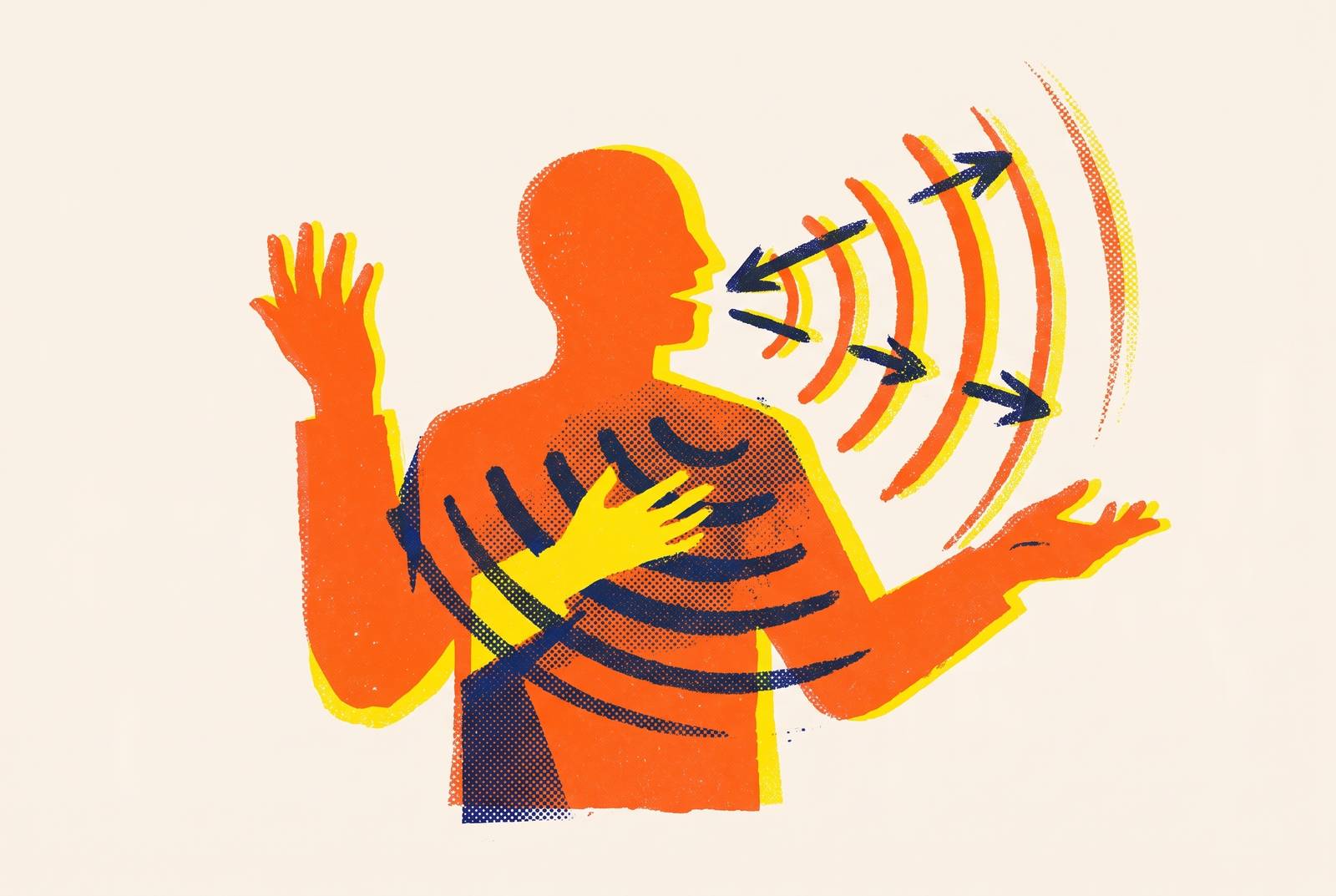
Physical presence is a second message running the whole time, and when that message disagrees with the words coming out of a mouth, the body wins the argument, not the mouth. It is a second message running the whole time, and when that message disagrees with the words coming out of a mouth, the body wins the argument, not the mouth. This is specific enough to train like a skill: most speaking advice treats posture and gesture as personality traits instead of drills.
Most people treat body language as something bolted on after the words are already doing the work: stand up straighter, remember to smile, don't forget to gesture. A study out of the University of Khartoum and University of Tabuk (Abbas and Mustafa, 42 participants, published in the Journal of Asian American Studies) found that nonverbal cues carry emotional information that deepens the verbal signal, so a combined message lands harder than either channel alone. Combining facial expressions with body movements has achieved 98% accuracy in identifying a person's true emotional state. The audience is using the face to decide which channel is lying, and that decision happens well before the argument itself gets evaluated on its merits.
Albert Mehrabian's famous 93%-nonverbal number gets dragged out constantly to argue that words barely matter, and this is where that stat gets mangled. Albert Mehrabian's famous 93%-nonverbal number gets dragged out constantly to argue that words barely matter. That reading is wrong, and it is wrong in a specific, checkable way: Mehrabian's finding applies to situations where verbal and nonverbal signals conflict, attitudinal communication where someone says one thing and their face says another. It is a warning label on incongruence, not a verdict on language, and treating it as the latter has misled a couple decades of speaking coaches into telling people that words don't matter much. Words matter plenty. They just lose the argument fast when the face contradicts them.
How the brain reads a speaker's body before words register
Research finds that people form trustworthiness judgments in about one-tenth of a second, faster than most people can finish reading this sentence out loud. The audience has already made a call on the speaker before the speaker has said a single word, so the opening posture is doing more persuasive work than the opening line ever will.
Roughly two-thirds of a first impression comes from nonverbal signals, with posture and facial expression doing the early labor of signaling competence before the mouth opens. Picture a speaker walking to the front of the room with shoulders curled forward, eyes down, jaw tight. Nothing has been said yet, and the audience has already discounted whatever comes next. The words now have to climb out of a hole that posture dug, and good writing cannot climb out of that hole nearly as fast as bad posture dug it.
The hole gets deeper if the mismatch continues once the talking starts. Inconsistencies across verbal, nonverbal, and visual channels undermine how credible a presenter seems. If a speaker smiles while delivering bad news, or looks anxious while claiming confidence, the audience does not just get confused. It starts to distrust the message actively, which is a meaningfully worse outcome than simple confusion, and a much harder one to recover from mid-talk.
Posture's effect on the speaker's own brain, not just the audience's perception
Posture is not only a signal broadcast outward. It changes what is happening inside the speaker's own head before anyone in the room reacts to anything.
Dr. Erik Peper at San Francisco State University ran a study on exactly this question. Around 87% of participants found it easier to recall positive, empowering memories while sitting upright, and around 86% found it easier to access negative, defeating memories while slouching, which is not a small effect. That means the posture a speaker holds while preparing, or even mid-sentence, shapes which memories and associations are cognitively available in that moment. It means the posture a speaker holds while preparing, or even mid-sentence, shapes which memories and associations are cognitively available in that moment. Slouch through a rehearsal, and the brain quietly stacks the deck toward self-doubt before a single word gets practiced.
Research on expansive postures backs this up on the confidence side: open, upright stances reliably increase self-reported confidence. Not dramatically, not universally, but reliably enough, across a body of research that size, to take seriously.
None of this calls for a power-pose performance in a bathroom mirror before walking on stage, and speakers who treat it that way are wasting two minutes on theater. Feet shoulder-width apart, shoulders relaxed, weight distributed evenly: that is the baseline, and it belongs in the warm-up category, not the etiquette category. A sprinter does not stretch because stretching looks disciplined. A sprinter stretches because the muscles need to be in a state that lets them fire correctly when the gun goes off. Posture does the same job for cognitive access. Skipping it means a speaker is trying to run cold.
How intentional gesture turns spoken points into persuasive events
Speakers who use illustrative hand gestures come across as 9% more persuasive than those who don't, and the top-rated TED speakers average 465 gestures per talk, significantly more than their lower-rated counterparts.
That 465 figure sounds enormous until it gets unpacked. Nobody is throwing 465 dramatic arm movements at an audience over eighteen minutes; that would look like conducting an invisible orchestra badly. Most of that count is small, illustrative movement: a hand opening slightly on the word "growth," fingers spreading apart to indicate scale, a palm turning up on a question. These are micro-gestures timed to emphasis, not theater, and mistaking one for the other is the single most common gesture mistake speakers make.
The distinction that actually matters is illustrative gesture versus nervous gesture, and most coaching never separates the two. Open-hand movements that track the content pull the audience toward meaning. Self-touching, fidgeting with a pen, adjusting a sleeve for the fourth time: these signal discomfort and drag attention toward the discomfort itself, away from the point being made. One category serves the message. The other leaks anxiety, and audiences read that leaked discomfort even when they cannot name what they are seeing.
Gesture also has to scale with the emotional register of what is being said. Wide, expansive movement tends to build excitement, while smaller, subtler gestures carry vulnerability or seriousness. A speaker who gestures at the same size and speed regardless of content is not wrong, exactly, just flat, the way a song sung at one volume the whole way through is technically music but forgets to be interesting.
Eye contact as a one-on-one illusion at scale
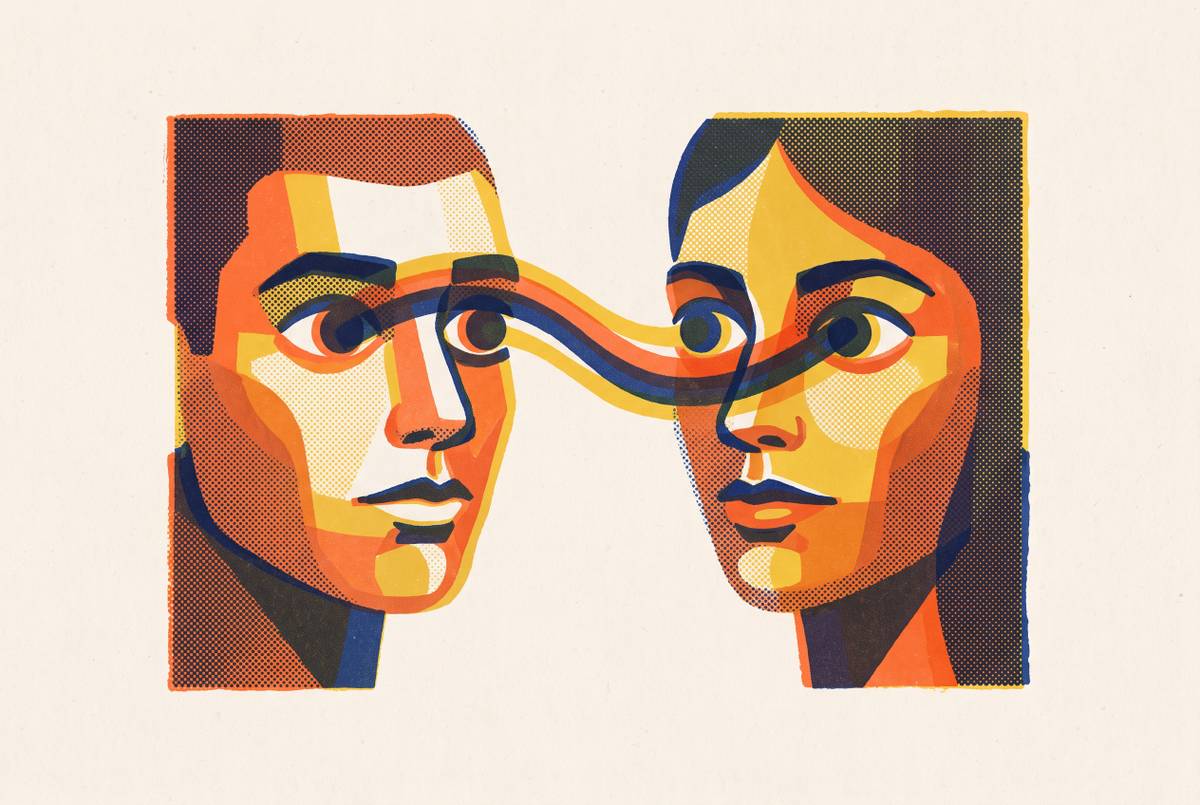
Holding one person's gaze for three to five seconds before shifting to someone else creates something close to an illusion: everyone in the room, or on the call, feels spoken to directly, even in a crowd of hundreds. That is the entire mechanism. It is a magic trick performed with attention instead of props, and it costs nothing to run.
Weak eye contact costs more than people expect. Scanning the room quickly, or avoiding gaze altogether, reads to an audience as low confidence or evasiveness, and audiences pick up on it faster than they could explain why something feels off. Argyle and Dean's research links sustained, balanced eye contact directly to higher perceived credibility, which lines up with a fairly intuitive rule: people trust the person looking at them more than the person looking at the floor.
Virtual settings complicate this in a specific way, and almost nobody fixes it. Looking into the camera lens, not at the little box showing your own face, is what simulates eye contact for a remote audience. Most speakers watch themselves instead of watching the lens, so the audience on the other end is quietly being looked at by nobody. Fixing that habit is not some deep neurological retraining project. It takes about a day of conscious practice, a piece of tape over the self-view window if that's what it takes, and the payoff is an outsized jump in how personal the call feels on the other end.
Facial expression, vocal variety, and the role of deliberate stillness
Paul Ekman's research on facial expression, cited in work by Dr. Anna Neya Kazanskaia and NEYA Global, established that basic emotional expressions get recognized across cultures with striking consistency. Translated to a stage or a boardroom: a speaker's face is broadcasting something at all times, whether that broadcast is intentional or not, and the version left running on autopilot is rarely flattering.
Congruence is the operating principle here. Smiling builds rapport, raised eyebrows signal curiosity or land emphasis, and a beat of stillness, holding a serious expression without rushing past it, lets a weighty statement register instead of getting stepped on by the next sentence. When the expression does not match the content, when someone delivers a somber statistic with a slight smile out of nervous habit, the audience notices the gap even without being able to name it.
Vocal variety runs on a parallel track. Speakers who use a wider range of pitch get rated as more engaging and more competent than speakers who stay in one flat tone, because pitch variation signals which points matter most. Diaphragmatic breathing is trained over shallow chest breathing specifically because chest breathing can trigger the body's fight-or-flight response, and that response degrades vocal control and clear thinking at exactly the moment a speaker needs both.
Mehrabian's often-cited breakdown assigns 55% of communicative impact to body language, 38% to vocal tone, and 7% to the actual words spoken. Whether those exact percentages hold up under scrutiny is a fair question, and researchers have pushed back on how broadly the numbers get applied. But the underlying point survives the argument: how something gets said, physically and vocally, does an enormous amount of work sitting right alongside the words themselves.
Physical signals tracking the arc of a story, not just a single moment
None of the signals above functions as a fixed setting. Good posture, steady eye contact, and expressive gesture are not a costume a speaker puts on once and wears unchanged for the full talk. They have to move with the story being told, which raises a real question: what happens when a speaker nails the physical fundamentals but holds them static through a talk that has actual narrative rise and fall? It flattens, no matter how technically correct the posture was at minute one.
Gesture and expression need to escalate with rising tension and release with resolution, or the story starts feeling like a report read aloud. The "5 Cs" framework, character, context, conflict, climax, closure, gives a useful map here, because each stage calls for a distinct physical register. The setup might warrant a calmer, more grounded stance. The conflict wants sharper gesture and faster vocal pacing. The closure needs to slow back down, physically, so the audience feels the landing instead of just hearing it announced.
A Prezi study found that 70% of audiences reported feeling more engaged when speakers used storytelling and personal anecdotes. That number comes with a catch: the engagement is conditional on delivery matching content. A story told with a flat, mismatched, or absent physical response underperforms its own material, no matter how good the plot is on paper.
Internalized and memorized delivery look most visibly different right here, and this is where the two approaches split hardest. A speaker who has internalized the key beats of a talk, rather than memorized it word for word, keeps the capacity for real eye contact and genuine physical reaction, because attention is not locked onto recalling the next exact phrase. Scripted, memorized delivery tends to produce something stiffer: a body that is technically present but not actually responding to the room.
The gap between knowing these signals and having them available under pressure
Everything above is describable. Most people, asked what good body language looks like, will list posture, eye contact, gesture, vocal variety, roughly in that order, without much hesitation. Asking those same people to produce all four reliably while standing in front of a room with their heart rate climbing makes the description fall apart fast.
That is the knowing-doing gap, and it is the reason so much communication advice fails to change actual behavior. About 75% of people experience some degree of public speaking anxiety, glossophobia. Nerves are the baseline condition every one of these physical skills has to survive. They are the baseline condition every one of these physical skills has to survive.
Anxiety has a specific physical signature, and it is not subtle once named: chest breathing instead of diaphragmatic breathing, shoulder tension, self-touching gestures, gaze that drifts off the audience. Each one directly undoes a signal covered earlier in this piece. Tense shoulders undercut the posture that keeps the brain in access mode. Averted gaze breaks the one-on-one illusion eye contact is supposed to create. Chest breathing chokes off the vocal variety that signals which points matter. Diaphragmatic breathing practice is a direct countermeasure aimed at this exact cascade, not a general wellness tip, and treating it as optional relaxation advice misses the point entirely.
These signals need to run on their own, because anything still requiring conscious attention under pressure is the first thing that gets dropped when cognitive load spikes. Nobody thinks about their diaphragm mid-sentence while also trying to remember their third point and read the room. Something gives, and it is usually the thing that was never drilled into muscle memory.
The benefits of daily short-form practice over occasional long rehearsal
If these signals need to become automatic, what kind of practice actually builds that automaticity? Not the kind most people default to, and this is the part where common wisdom gets it backwards. The weekly two-hour rehearsal that most people treat as serious preparation is, by the research, close to wasted effort compared to showing up daily for a fraction of the time. Ten to fifteen minutes of daily practice produces steadier gains in articulation and lower anxiety than a single two-hour session once a week. Same total time, spent very differently, with very different results, and frequency is doing the work that duration gets credit for.
Structured habit interventions, ones that combine actual practice with recording and reflection, have shown self-reported confidence gains of up to 30% within four weeks. The recording step is not incidental to that number; it is doing real work. Watching a recording is the only practical way to see posture, gesture, and facial expression the way an audience sees them, rather than the way they feel from the inside. Most speakers have no idea they touch their face every twenty seconds until they watch the footage back and count for themselves.
Specific drills produce gains that vague "practice speaking more" advice does not, and this is where most self-improvement plans go soft. Impromptu speaking exercises build resilience for the moments a talk goes off-script. Deliberate distraction practice, rehearsing while something interrupts or throws off timing, builds the physical composure needed to recover without the whole delivery collapsing. Small real-world reps, asking a colleague for direct feedback, introducing yourself to a stranger at an event, function as low-stakes training sets for the exact same nervous system response that shows up on a bigger stage.
None of this produces a naturally gifted public speaker, whatever that phrase is even supposed to mean. It builds something closer to strength training for a set of physical signals; the brain and the audience are both reading them constantly, regardless of anyone in the room paying conscious attention to them.