Eye Contact Rules That Actually Build Connection
Timing and sequencing your gaze matters far more than how long you stare.
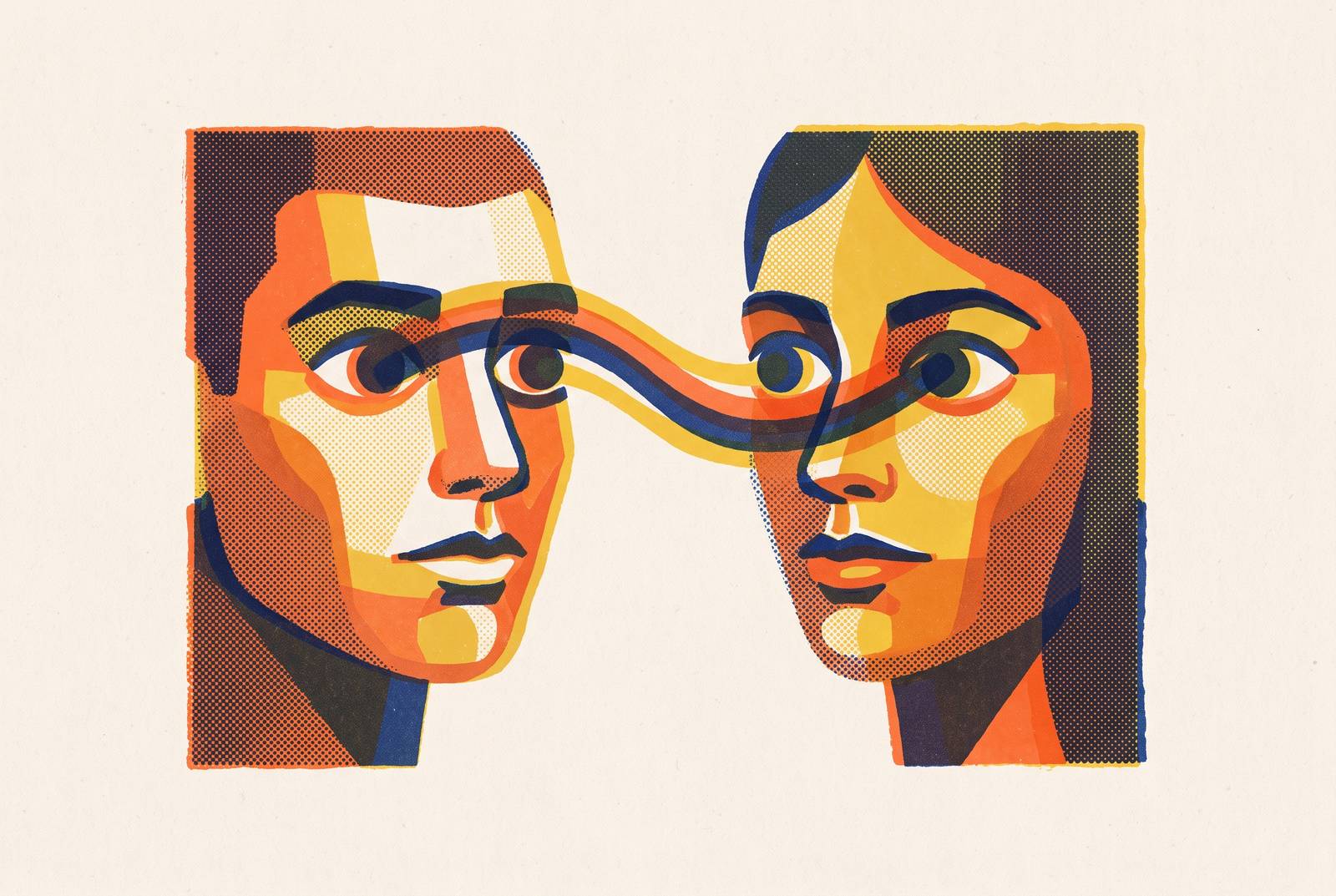
Most eye contact advice comes down to one instruction: make more of it. Hold the gaze longer, do not look away first, treat eye contact like a dial to crank up whenever confidence needs signaling. That framing gets the mechanism backward. The skill is not volume, it is sequencing, and gaze-timing research suggests the "when" shapes perceived confidence far more than the "how much" ever did.
What happens in the brain during eye contact
Two strangers lock eyes and something measurable shifts. Studies on gaze and attraction have found that eye contact between strangers can produce sharply higher feelings of affection, liking, and something researchers have called, with a straight face, "passionate love." That is a strong claim for an act that takes under a second to start, but the mechanism producing that reaction is well documented.
When two people hold a gaze, their neural activity starts to line up, a phenomenon researchers call interbrain synchrony: measurable coordination between two nervous systems that produces a shared emotional state and, oddly, a shared sense of purpose. It is as if the look does part of the negotiating before either person opens their mouth. Some of this appears to run through mirroring processes between nervous systems, a neural call-and-response happening well beneath conscious notice.
Direct gaze also leaves a memory trace. Research has found that even a modest amount of it during an exchange, something in the range of 30% of total interaction time, boosts recall meaningfully. This holds even on video calls, where true mutual gaze is more approximation than direct contact. So a little goes further than most people assume, which is either reassuring or mildly humiliating, depending on how much effort has gone into holding a stare for an entire conversation out of some misplaced sense of duty.
The Flinders University finding that reframes the whole conversation
If the brain science says eye contact matters, a study out of Flinders University says most of the advice about it has been aiming at the wrong target.
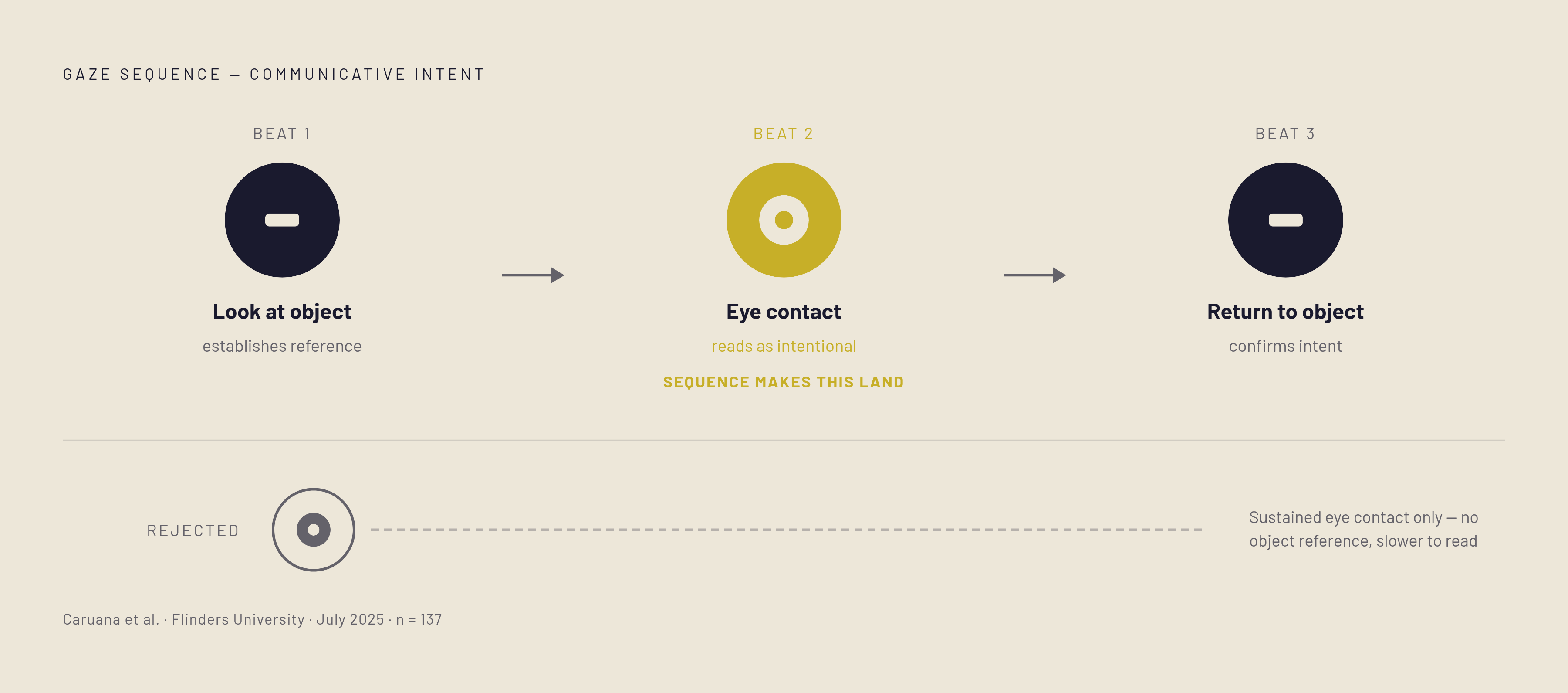
Nathan Caruana and colleagues published "The temporal context of eye contact influences perceptions of communicative intent" in a journal (issue 12, No. 7, July 16, 2025), with a sample of 137 participants. The setup had people working through a block-building task alongside a virtual partner, while researchers manipulated the sequence of gaze shifts to find out when a look actually registers as a request for help, as opposed to a glance that just happened to land on a face.
The winning sequence was not sustained eye contact. It was look at the object, make eye contact, then look back at the object: a three-beat pattern that made participants both quicker and more confident in reading the gaze as a real signal rather than a coincidence of eye movement. Caruana said: "it's not just how often someone looks at you, or if they look at you last in a sequence of eye movements, but the context of their eye movements that makes that behavior appear communicative and relevant."
That finding should embarrass the entire "hold it longer" school of eye contact coaching. Duration was never the variable doing the work; sequence was, and most advice has been optimizing the wrong number for decades. Staring at someone until they notice is a standoff. Pointing at something with the eyes precisely enough that someone else cannot help but follow is a conversation. Those are different acts wearing the same face.
The role of context in making a look feel natural
If sequence beats duration, how does anyone know when to use it? Context decides, and the concept that ties it together is mutuality. The goal, as communication writers like Michael Ellsberg have explored, is not sustained gaze but comfortable reciprocity: connection that feels natural rather than rehearsed. The moment eye contact starts to feel like a performance for either person, the mutuality collapses, and the whole exchange reads as pressure instead of presence.
Breaking eye contact mid-conversation gets misread as a failure of nerve when it is closer to basic cognitive housekeeping. Bill McGowan, communication coach and co-author of Speak, Memorably: The Art of Captivating an Audience, notes that people look away because they need mental space to think about what comes next. Staring at someone staring back does not give the brain that room. So the advice to "never break eye contact" is not just impractical, it works against how thinking actually happens in real time.
Communication coaches often lean on a rough heuristic, the 50/70 rule: about 50% eye contact while speaking, 70% while listening. It is not a precise experimental finding so much as a working shorthand built up through practice. Held loosely, it is a decent starting point. Held rigidly, it becomes the same volume-dial trap this entire piece is trying to talk people out of. A useful companion number is duration per glance, a few seconds of contact at a time: long enough to register as attention, short enough to stop short of a stare-down.
What eye contact signals: presence versus pressure
Context decides which side of that line a look lands on, and nowhere is that clearer than the split between listening and speaking.
Active listening runs almost entirely on gaze. Holding eye contact while someone else talks signals attention, validates what is being said, and helps manage turn-taking, since gaze is one of the main ways people signal whose turn it is to speak. Cutting that gaze off mid-listen can disrupt the rhythm of the exchange, signaling to the other person that the moment of attention has passed.
That single beat of contact before speech starts primes the listener and signals that what is coming is intentional. It is a small habit, almost invisible to anyone watching, but it changes how the sentence that follows actually lands.
Negotiation flips the stakes. Negotiators who glance away right as they finish a sentence, every single time, can undermine their own credibility without knowing it. The mismatch between what the moment calls for and what the eyes are doing can carry a real effect on how competence is read. The mismatch reads as evasive even when nothing evasive is happening; the eyes are just doing something the words are not backing up.
The opposite failure is forced, unbroken gaze, and it deserves more suspicion than it usually gets. Holding eye contact too long and too rigidly stops signaling connection and starts signaling aggression, or something worse: performance. A look that ignores sequence and context destroys mutuality just as surely, only in the opposite direction.
Eye contact in public speaking: why looking down is worse than you think
One-on-one, gaze management stays subtle. In front of a room, it becomes load-bearing. Public speaking coaches describe eye contact as central to the whole act in both a boardroom pitch and a keynote, because darting eyes or a gaze drifting toward the ceiling while a speaker hunts for the next sentence reads as anxiety, even when the content itself is sharp and well-argued.
Looking down does not just cost a speaker in that one moment, it compounds. Less eye contact produces a weaker connection with the room, which produces a more nervous speaker, which makes re-establishing eye contact even harder the next time, and the cycle feeds itself. It is less a tic and more a feedback loop, the way one off note in the first bar of a song gets harder to fix the longer the band keeps playing through it.
The standard countermeasure is a 3 to 5 second rule: pick one person, hold real eye contact through one complete thought (roughly 3 to 5 seconds), then move to someone else. That window is not arbitrary; it maps to how long it actually takes to finish a single spoken thought, so the speaker's focus stays anchored instead of flicking around the room mid-sentence.
For rooms too large or too dark to track individual faces, there is a workaround, and it is closer to stagecraft than neuroscience: before speaking, pick 3 to 4 fixed spots, say center, left, right, and one slightly higher toward the back, and rotate through them on purpose. It produces the visual effect of engagement even when genuine one-on-one contact with every face in the room is not physically possible.
The competitive edge eye contact creates in interviews and high-stakes conversations
Interviews compress all of this into a smaller, higher-pressure window, and the research lines up with what most hiring managers already sense without being able to name it. Career coach Dawid Wiącek, writing for The Muse, calls eye contact "a powerful nonverbal communication tool in job interviews," noting that used well, it demonstrates confidence, engagement, and authenticity, qualities employers weigh heavily no matter how the actual answer holds up.
The failure mode is oddly specific. Candidates who glance off to the side horizontally, rather than up, down, or straight at the interviewer, tend to read as less hireable and less present, even when the substance of the answer is fine. The gaze direction does damage the words never see coming, and no amount of a strong answer fully undoes it.
Some of this traces back to a basic trust mechanism: brains use eye behavior as one shortcut for gauging honesty. Candidates who hold appropriate gaze get judged as more dependable before they have said much of anything: the first few seconds of eye contact in an interview are doing reputational work well ahead of the actual content.
The signal matters enough that researchers have started studying whether it can be faked convincingly. A paper from the 2025 CHI Conference on Human Factors in Computing Systems examined simulated eye contact on video calls, choosing the job interview specifically as its test case because it is, in the paper's own words, "a typical case where simulated eye contact is recommended and employed." That researchers have turned attention to replicating this signal over a webcam says something about how much weight it carries.
How to build this skill through daily practice
None of this calls for a seminar or a mirror-based drilling routine. It calls for reps, and the Flinders University research gives a concrete one: look at the object, make eye contact, look back at the object. Low-stakes settings, ordering coffee, checking in with a coworker, are the right place to practice that beat before trying it in a negotiation or an interview, where the cost of fumbling it climbs fast.
Start every conversation with eye contact before the first word leaves the mouth. It is a small habit, and the feedback is immediate, since the other person's reaction gives it away within a second: intentional, or just a bit odd.
Practice holding eye contact for one complete thought, a single sentence, then move on. That mirrors the 3 to 5 second window recommended for public speaking, and it builds the muscle without needing an actual audience to test it on.
And notice when gaze breaks, and why it broke. Breaking eye contact to think is normal, a basic cognitive need rather than a social failure. The actual goal is returning to it on purpose, deliberately, rather than avoiding it out of discomfort or forcing it well past the point where it stopped feeling mutual and started feeling like an interrogation.
Sources
- It’s not that you look—it’s when: The hidden power of eye contact
- Synchronization of brain activity associated with eye contact: comparison of face-to-face and online communication | Scientific Reports
- Eye contact marks the rise and fall of shared attention in conversation | PNAS
- Social synchronization of brain activity increases during eye-contact | Communications Biology
- news.flinders.edu.au
- researchnow.flinders.edu.au
- coopervision.com
- dl.acm.org