How Accent Shapes First Impressions Before You Finish a Sentence
Accent bias shapes hiring and courtroom decisions before conscious thought kicks in.
Accent bias starts working on a listener before the listener has heard a full sentence, sometimes before they've heard a full word. This piece traces that process from the millisecond judgment in the brain to the hiring decision, the courtroom, the voice assistant, and finally to what a speaker can actually do about it.
Early brain responses to an unfamiliar voice
Speed is the whole story here. A listener's brain starts sorting a speaker into categories of trustworthiness, competence, and status within milliseconds of the first sound, long before the conscious mind has caught up to what word is even being said. The amygdala and cortex run this evaluation so fast that there's no real window for deliberate override. By the time a person decides to pay attention to content, the social read has already happened.
Researchers call this the "thin-slice effect. Within the first seconds of hearing a voice, a listener has effectively already guessed at a speaker's background, education level, and reliability, all before that speaker has said anything that could actually demonstrate competence. That timing means the content of a sentence arrives too late to correct a first impression that's already locked in.
What drives that snap judgment? Maindidze et al.'s meta-analysis found that accent bias is predicted strongly by evaluators' stereotypes about lower competence, and to a lesser extent by stereotypes about lower warmth. Notice what's missing from that list: how hard the accent actually was to understand. Comprehension difficulty isn't the engine. Stereotype is.
A second mechanism piles on top of that stereotype activation. Sounds that are unfamiliar to a listener take longer to process, and the brain tends to read that extra processing time as a drop in credibility, which means part of the penalty against unfamiliar accents has nothing to do with judgment of intelligence and everything to do with the listener's own cognitive friction. Decades of film casting and news broadcasting have also trained listeners to pair certain accent patterns with authority and others with villainy or incompetence, so most evaluators walk into any new encounter already primed by a lifetime of media association. So the mechanism is physiological speed plus cultural priming, and they work together before a single word has registered as meaning.
Accent bias is a social penalty, not a comprehension problem
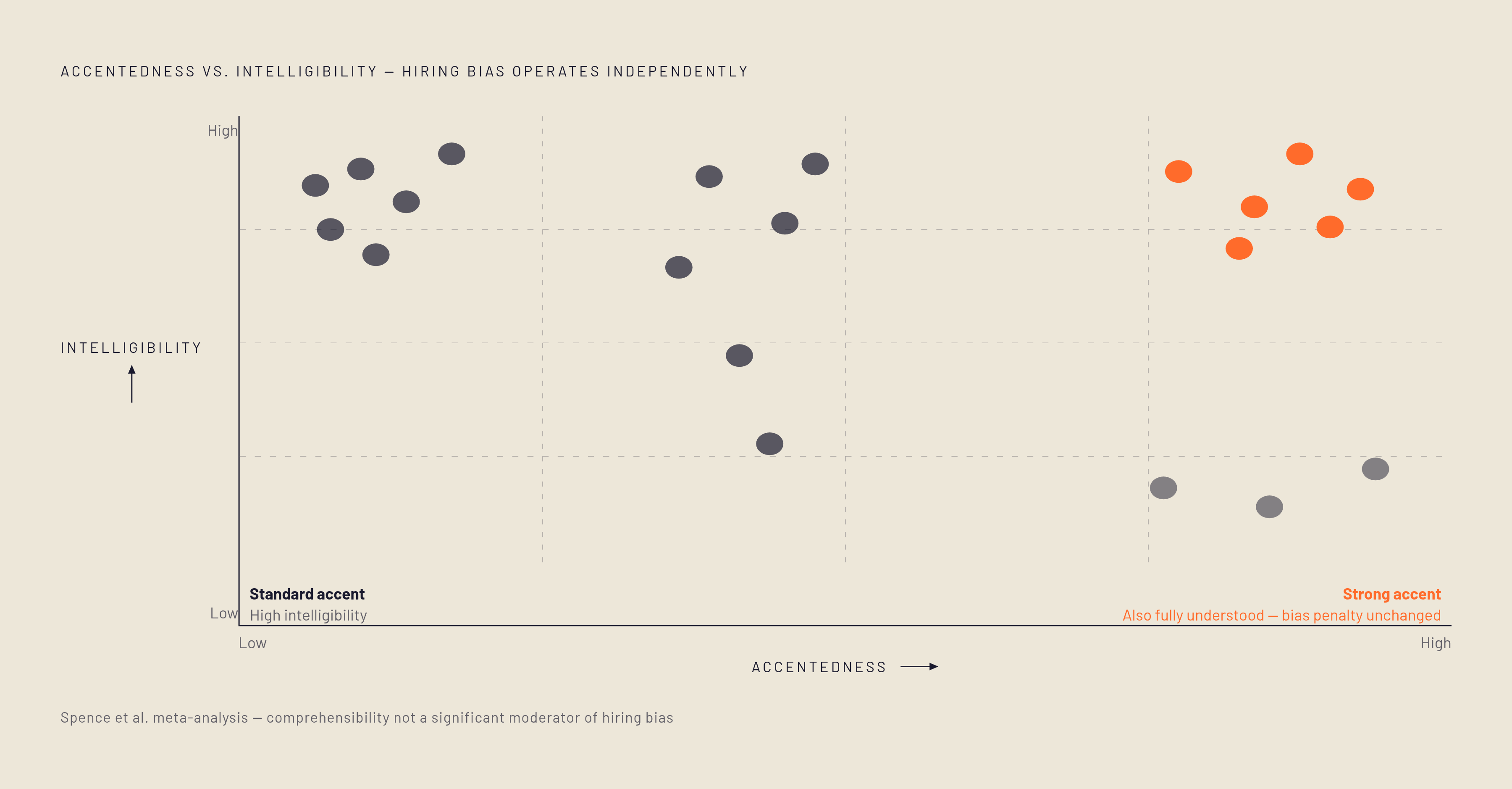
Accentedness and intelligibility are largely independent of each other. A speaker can carry a heavy accent and still be fully understood, but you still pay the full social cost anyway. That's the finding that reframes everything that follows.
A 2025 meta-analysis in Studies in Second Language Acquisition draws a clean line between two things that get casually lumped together: accentedness, meaning how different a voice sounds from some reference norm, and intelligibility, meaning how clearly that voice is actually understood. Fluency correlates strongly with comprehensibility. Accentedness correlates weakly with intelligibility. Those are two different axes, and conflating them is where a lot of casual thinking about "hard to understand" accents goes wrong.
Spence et al.'s meta-analysis backs this up, but from the hiring side. Candidates' relative comprehensibility was not a significant moderator of hiring bias. Evaluators penalized non-standard accents even when they understood the speaker without any difficulty. The listener isn't struggling to parse the words. The listener is running a fast social-categorization routine, and the accent is simply the trigger that routine responds to.
One might argue the obvious objection here: people just find heavy accents harder to follow, and that's a fair, natural thing to assume. The research doesn't leave much room for it. Comprehensibility doesn't drive the penalty, stereotype does, and that distinction is the reason the fix for accent bias was never going to be pronunciation drilling aimed at erasing an accent. If the problem were genuinely about clarity, the solution would be phonetic correction. Because the problem is about perception, the solution has to be about framing, pacing, and presence, which is exactly where this piece ends up by its final section.
Where the penalty lands: hiring, promotion, and the courtroom
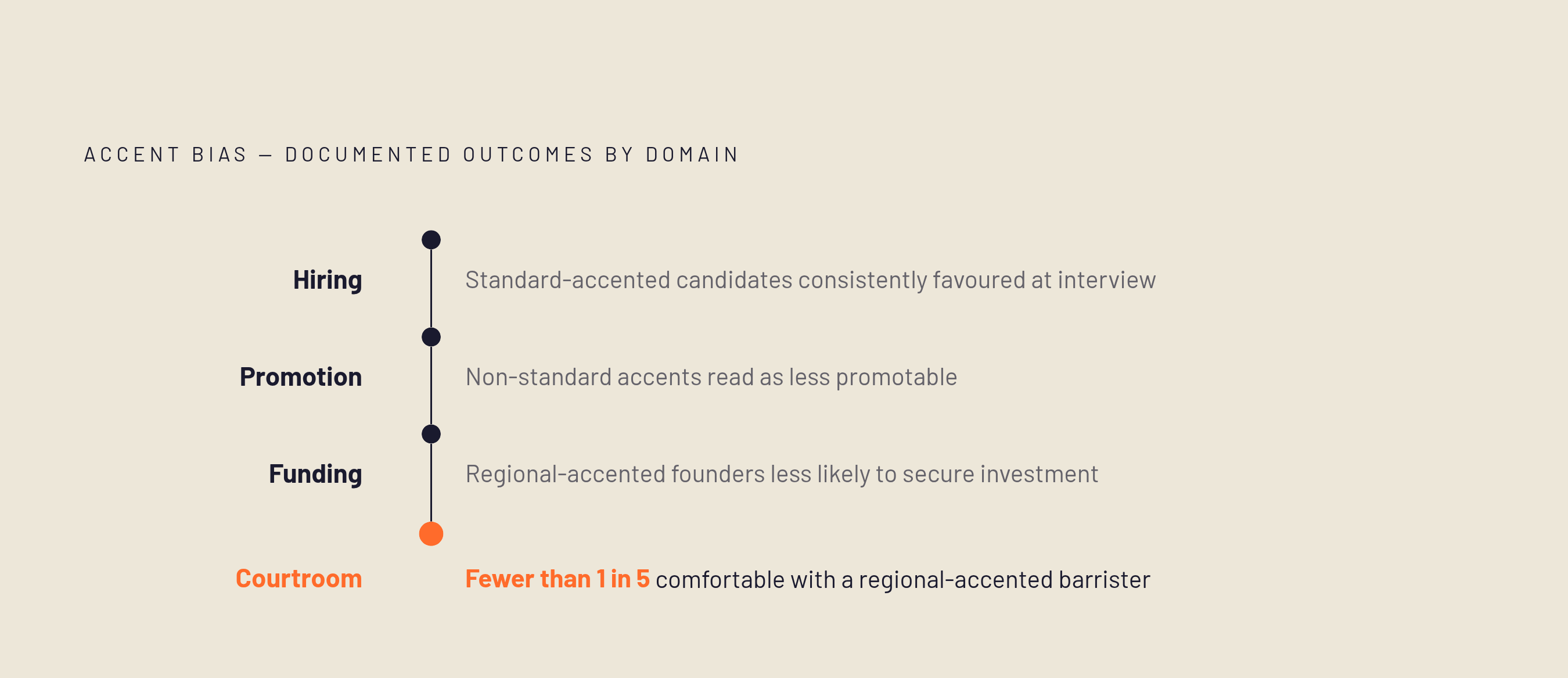
That social penalty isn't an abstract psychological curiosity. That penalty is visible in hiring, promotion, and legal credibility, and the body of evidence behind it is now large enough to call a pattern rather than a fluke.
Maindidze et al. (2025), working from a large pool of participants across many separate studies, found that standard-accented interviewees are consistently favored over non-standard-accented interviewees in hiring contexts. The same meta-analysis found the bias is predicted strongly by evaluators' stereotypes of lower competence and lower warmth attributed to non-standard-accented speakers, which lands the penalty exactly where speaking well is supposed to count for the most.
The disadvantage doesn't stop at the interview. Compared to standard-accented peers, non-standard-accented workers are seen as less promotable once they're inside an organization, and they're less likely to get entrepreneurial funding when they pitch as founders. One might ask: does this hit everyone the same way, and the answer is no. The same 2025 meta-analysis found accent bias is stronger against women than men, particularly when the evaluator pool is predominantly female, a pattern that resists easy explanation and suggests the bias runs deeper than a simple reaction to "sounding foreign." A separate study from Browne Jacobson and the University of Nottingham, built on 250 in-depth interviews and survey responses with professional services workers in the UK in 2025, found this plays out in real time inside meetings: participants described having contributions dismissed with eye-rolls before they'd even finished a sentence. The bias is alive in the room, not just confined to the hiring panel.
Legal perception sharpens the picture further. A year-long study by Nottingham Trent University and De Montfort University looked at how the public perceives barristers and found a strong preference for South East or Received Pronunciation accents. Speakers with regional accents were judged as less intelligent or less professional, even though those same regional accents scored higher on trustworthiness and likeability. Fewer than a fifth of respondents said they'd feel comfortable being represented by a barrister with a West Midlands or South West accent. In a profession where perceived authority is the entire currency, that's not a small gap to be standing on.
Accent bias in AI systems and voice technology
Accent bias used to live entirely in human judgment. It now lives in code too, built into the systems that transcribe, evaluate, and respond to speech at a scale no single biased interviewer could ever match.
Liang and Wassink's study, presented at ACM FAccT, surveyed speakers across four U.S. dialect communities: African American speakers in Atlanta, Gulf Coast Creole and French speakers in Mississippi and Louisiana, Hispanic and Latine Caribbean speakers in Miami Beach, and Native American speakers in Tucson. Most participants across these communities felt that voice technology failed to account for their cultural backgrounds and required constant adjustment just to achieve basic functionality. The emotional toll wasn't limited to frustration. Participants reported feelings of inadequacy, even while recognizing, correctly, that the failure sat with the system and not with them.
That recognition points to a kind of labor that rarely gets counted. Speakers of non-dominant varieties routinely code-switch, over-articulate, and manage their own frustration just to make a voice assistant or transcription tool work as intended, labor that a standard-accented user never has to perform and that no system logs as a cost anywhere in its design.
The bias runs in the other direction too. Hercula et al. found that evaluators gave lower fluency ratings to Irish, Indian, and South African virtual assistant voices than to American voices. The penalty doesn't only land on the humans being evaluated by machines. It also lands on the synthetic voices machines use to talk back to people, which means the same hierarchy of accent prestige has been built into both ends of the conversation. Anyone communicating through a digital channel today, which is most people most of the time, is operating inside an environment already calibrated against non-standard vocal patterns. If the infrastructure itself is tilted, speakers can't just wait for it to catch up; the question is what they actually do about it, day to day.
Gen Z, code-switching, and accent pressure
Younger speakers aren't simply absorbing this pressure passively: they're managing it, actively and often skillfully, through code-switching, a practice that has shifted from something people did to get by into something increasingly recognized as a genuine communicative skill in its own right.
Code-switching is evidence of full mastery of both languages, with switching between them serving as the method by which these speakers actively build a bilingual, bicultural identity rather than settle for one half of it. That reframes something that older models of bilingualism sometimes treated as a deficiency, turning it instead into a demonstrated range.
You see the same flexibility in peer settings, away from anything professional. Gen Z's strategic use of slang and accent variation builds group cohesion and signals emotional authenticity among friends, and the same speaker who shifts into a polished professional register in a job interview will lean into accent and slang with peers to signal belonging there instead. Neither version is the "real" one standing behind a fake one. Both are deployed on purpose, for different rooms.
Not every signal points toward confidence, though. Over 77% of people working in creative industries have felt pressure to change their accents, a figure from Empoword Journalism's reporting that is now feeding directly into anti-bias policy conversations inside those industries. And the Browne Jacobson and University of Nottingham research found that many professionals don't experience accent bias as some distant structural issue they read about. They experience it as personal and ongoing, a small indignity that repeats. That tension, between code-switching as mastery and accent bias as a felt daily cost, is why the next section matters: the goal isn't to make the pressure disappear by pretending it isn't there, but to build a vocal practice that gives a speaker more range and more control over how they're heard.
Clarity, pacing, and deliberate vocal presence
If the penalty runs on stereotype rather than on comprehension difficulty, then the fix was never going to be accent elimination. The lever that actually works is a set of learnable vocal behaviors that signal confidence and intentionality to a listener, independent of where that listener places the accent itself.
Perceived fluency is built mostly from pacing, stress, rhythm, and intonation, not from the precise shape of individual sounds. If you work deliberately on those four elements, you can keep an accent fully intact and still change, substantially, how you come across. A 2025 study published in Higher Education Studies found that students who completed a targeted public speaking program showed a real improvement in self-confidence along with a drop in public speaking anxiety. Structured practice produced a measurable shift, not just a felt one.
What kind of structure, though? The research points toward repetition with feedback, not occasional long sessions of preparation. Short, consistent daily practice produces gains that hold up better over time than infrequent, intensive cramming before a big presentation. And the hierarchy that makes all of this necessary isn't fixed in stone everywhere. A replication study in Brazil, published in Applied Linguistics in December 2024, found that listeners did not uniformly favor speakers of the locally dominant variety. In some conditions, they actually preferred speakers from other language backgrounds. The standard-accent hierarchy is a pattern built by exposure and context, which means it can shift.
Tools that score your pronunciation and fluency with specific feedback put this principle into daily practice. Cambridge's Speak & Improve, free and browser-based, draws on the University of Cambridge's own research into automated speaking assessment. BoldVoice pairs AI feedback with guidance from Hollywood accent coaches, and it gives you daily lessons tailored to you. Both represent the same underlying method: practice daily, get scored, close the loop, repeat. Any tool built on that same cycle, daily attempts scored against clear criteria, belongs in the same category. The tool matters less than the mechanism: short reps, specific feedback, visible progress.
Building the habit that compounds vocal confidence over time
Vocal presence behaves less like a fixed trait and more like an athletic skill: it responds to deliberate daily repetition, specific feedback, and progress a person can actually track over time. That framing matters because it turns a problem that can feel unfair and immovable into one with an actual training plan attached to it.
The practice structure the evidence supports is narrow and specific: short daily sessions built around a specific prompt, immediate scored feedback on delivery rather than just on content, and a clear way to track improvement from one attempt to the next. Occasional workshops or passive listening don't give you the same compounding effect that short, frequent reps do.
Pacing is the first lever to pull, and it happens to be the most transferable one. Slowing down even slightly signals confidence and gives a listener's brain the extra beat it needs to calibrate to an unfamiliar vocal signature. Recall the novelty penalty from the very first section: unfamiliar sounds slow processing and get misread as reduced credibility. A controlled pace works directly against that effect by giving the listener's brain time to catch up, which shrinks the penalty before it has room to form.
Practicing where emphasis naturally falls in a sentence, and how intonation signals certainty instead of hesitation, shifts listener perception faster than drilling specific sounds, because stress and rhythm carry more weight than any individual phoneme. And code-switching, covered in the section before this one as a form of mastery rather than compromise, deserves the same deliberate practice. Knowing when to shift toward a more standardized register and when to lean fully into a natural vocal identity is itself a trained skill, built by training that produces range, not uniformity.
What separates two equally capable speakers in a high-stakes room, an interview, a pitch, a courtroom? Often it's which one trained their voice daily and which one only thought about it once the stakes had already arrived. The brain's first-fraction-of-a-second judgment, covered at the start of this piece, never fully goes away. But the research throughout shows that judgment is only the opening bid in a conversation a trained speaker can still win.
Sources
- Is Your Accent Right for the Job? A Meta-Analysis on Accent Bias in Hiring Decisions - Jessica L. Spence, Matthew J. Hornsey, Eloise M. Stephenson, Kana Imuta, 2024
- A Meta‐Analysis of Accent Bias in Employee Interviews: The Effects of Gender and Accent Stereotypes, Interview Modality, and Other Moderating Features - Maindidze - 2025 - International Journal of Selection and Assessment - Wiley Online Library
- "This Wasn't Made for Me": Recentering User Experience and Emotional Impact in the Evaluation of ASR Bias
- Bias toward the Accents of Virtual Assistants - Sarah E. Hercula, Daniel B. Shank, Jessica L. Cundiff, David Wright, 2024
- Accent Bias in Professional Evaluations: A Conceptual Replication Study in Brazil
- Modern Notions of Accent-ism: Findings, Conceptualizations, and Implications for Interventions and Research on Nonnative Accents - Janin Roessel, Christiane Schoel, Dagmar Stahlberg, 2020