TikTok Charisma and the Rhetorical Formula Behind Viral Talking-Head Videos
The six rules that make talking-head videos stop the scroll.
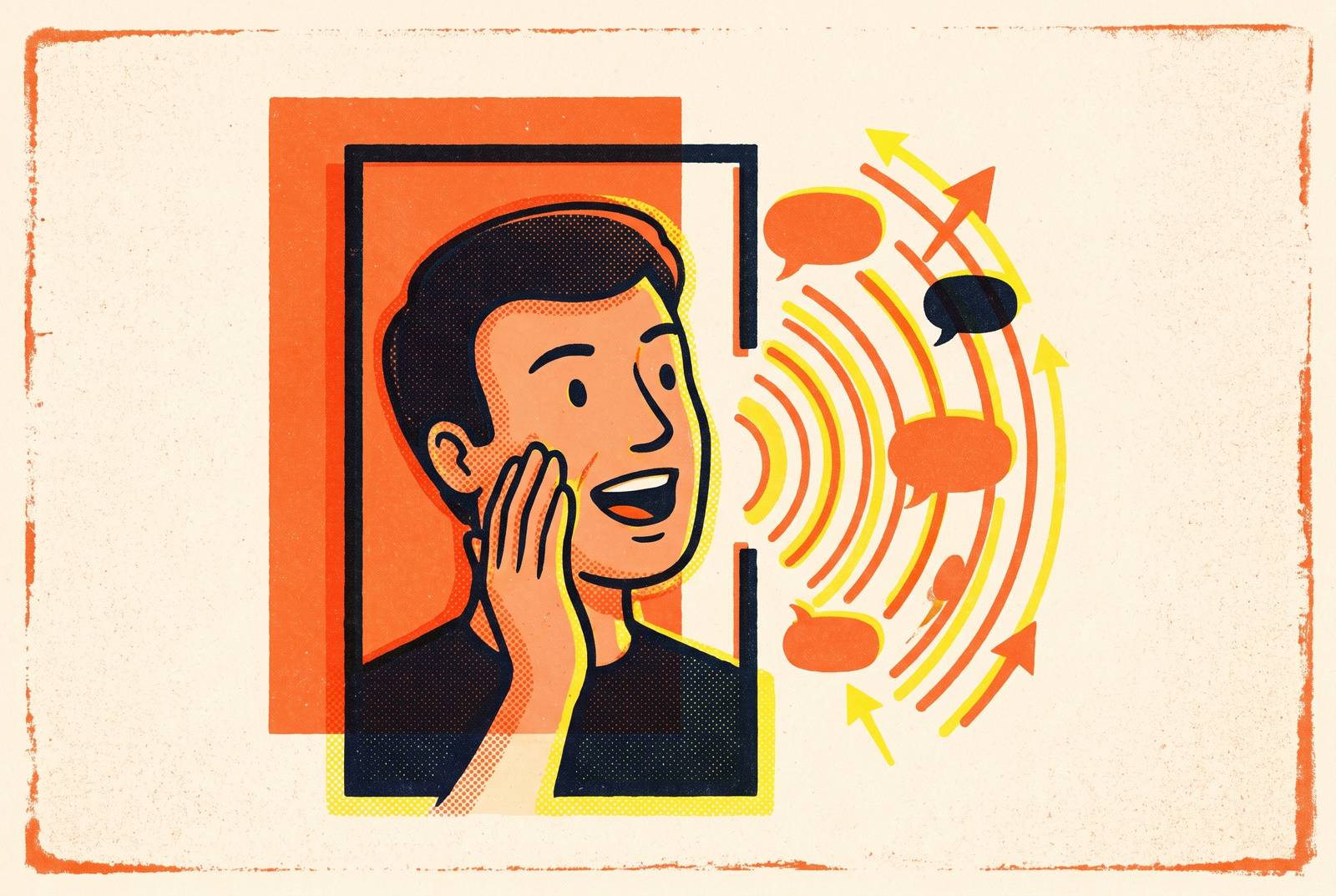
One person, one camera, one idea: that configuration has become the single highest-leverage format for building an audience on TikTok, and the reason has nothing to do with production value. A talking-head video strips away every advantage a creator might otherwise lean on: no editing trickery, no trending audio doing the emotional labor, no backup dancers, no B-roll to paper over a weak idea. What remains is the quality of what someone says and how they say it, exposed without cover.
That exposure is the whole mechanism. Facing a camera and delivering a clear idea in a steady voice reads, to a viewer scrolling at two-second intervals, as a signal of confidence: this person has something to say and is willing to be seen saying it. And the trust it builds compounds commercially. The format's apparent simplicity is what makes it difficult to fake, and that is the problem the rest of this piece addresses.
The six ways most talking-head videos fail before the first sentence ends
If the format is this stripped down, the failure modes should be easy to spot, and they are, once named. Most talking-head videos fail because they break specific structural rules that decide, within the first second or two, whether a viewer stays or swipes away, and all six of those rules are fixable the moment they are visible.
The first failure is opening with a greeting or a preamble, the "Hey guys, so today I wanted to talk about" problem, which burns the only truly free attention a creator gets. The second is failing to interrupt the scroll, visually or verbally, in that same opening moment, so the video blends into the feed. The third is withholding the payoff instead of teasing it immediately, as if suspense earns patience on a platform where patience does not exist. The sixth is closing on a passive call to action, "let me know in the comments," which deflates the very loop the video spent fifteen seconds building.
None of these six requires more talent to fix. Each one requires noticing it. A talking-head video that avoids all six is not following a restrictive formula so much as clearing away the specific things that make a viewer leave, which is a different way of thinking about structure than "rules." That reframe is what sets up the positive version of the formula in the next section.
The three-part rhetorical structure the best talking-head videos follow
The talking-head videos that hold attention longest tend to follow the same three-part shape: a hook, a one-idea body, and a clean close. That structure maps onto rhetorical technique that predates the platform by millennia, and it can be planned in two sentences before the camera ever starts recording.
The hook is the first sentence, with no exceptions and no warm-up. It has to do three things at once: arrive immediately, interrupt the scroll, and tease the payoff the rest of the video will deliver. Patterns that reliably do this include "The biggest mistake I see [audience] make is…", "I changed my mind about X. Here's why.", "If you're [doing X], stop.", "Three things I wish I knew before [milestone]…", "The reason your [thing] isn't working is…", "I just spent [time or money] on X. Here's what I learned.", and "Most people get this wrong. Here's the truth." The hook's job is to earn the view. The body's job is to earn the follow. Those are two different problems, and conflating them is how creators end up with a strong open and a forgettable middle.
The body carries exactly one idea, never two, never three. If a creator has three ideas, that is three videos, not one crowded one. Whatever answers that question is the idea, and it is the only idea that belongs in the video. The script, if there is one, should cover only the hook and that one idea; the body itself is better spoken than read, because a read body sounds like one.
The close lands the payoff the hook promised, or it opens the next question. It does not trail off, and it does not hand the energy back to the viewer with a passive request for comments. A structure this tight sounds almost too simple to call a formula, and that is a fair reaction. But tight is the point: a shape loose enough to require notes is a shape too loose to hold attention for fifteen seconds.
The hook archetypes that generate the most retention
Among every variable inside a talking-head video, the hook archetype chosen decides whether the platform's algorithm ever tests the video with a wider audience.
The pattern interrupt opens with a movement, a visual, or a statement that does not belong in the context the viewer expects. It disrupts the automated scroll reflex before the brain finishes deciding to keep moving. It wins the fight before the viewer consciously registers that a fight is happening. The POV or identity framing, "POV: you just found the hack that saves you [specific thing]," puts the viewer in the driver's seat rather than positioning the creator as a vendor pitching from outside. That framing works especially well in the single-person, headphones-on context most TikTok viewing happens in, reinforcing the sense of a private, direct address.
The single highest-converting hook archetype across platforms, by UGC Copilot's 2026 framework, is the transformation narrative: "I went from [bad number] to [good number] in [timeframe] using [thing]." Other strong performers follow the same underlying logic through different doors. "I was today years old when I found out [surprising fact]…" uses casual confession to signal relatability and lower the bar for sharing.
What ties all of these together is not tone or topic but function: each one opens a question in the viewer's mind that the rest of the video promises to close. Watch time, the metric the platform actually optimizes for, is effectively a measurement of how many viewers stuck around to see that loop resolve.
The delivery moves that separate a watchable talking head from a forgettable one
Structure gets a video built correctly on paper. Delivery is what decides whether anyone wants to watch the thing once it exists, and the gap between the two is where most "I have the formula but it's not working" complaints actually live.
Slowing down is the single highest-leverage delivery move available, and it runs against most people's instinct on camera. A strong talking head also signals its emotional register within the first few seconds, sad, infuriating, heartwarming, or funny, so the viewer knows what kind of attention to bring and does not spend the first ten seconds recalibrating.
Viewers are also unusually sensitive to whether the speaker actually knows the subject. Talking for the sake of talking does not hold attention past the hook; the topic needs to stay tightly defined, free of detours, with a speaker who sounds like they have earned the right to be the one explaining it. None of this is about charisma in the sense of being naturally magnetic. It is a set of specific, visible behaviors, and the body of the video, where these behaviors live, is what actually earns the follow. The hook gets someone to watch fifteen seconds; the delivery inside the body is what gets them to tap the name at the bottom of the screen.
The compressed storytelling pattern that won August 2026
The three-part structure describes what wins on the platform right now, not just what won two years ago. The clearest signal from August 2026 is that it does. The posts performing best that month were not vague teasers promising something interesting later on; they stated the situation immediately and let the video itself supply the proof, the reaction, the transformation, or the punchline.
That pattern is the hook-body-close structure appearing not only in the spoken content of the video but in the composition of caption and video together; the formula has scaled beyond delivery technique into how creators frame a post before a viewer even presses play. Watch time remains the dominant ranking factor behind what the algorithm chooses to push further, and a structure built around a hook that demands resolution, a body with no detours, and a close that does not trail off is, by design, the architecture most likely to maximize exactly that metric. The formula was not reverse-engineered from a single viral month. The August 2026 pattern is what that formula looks like when it is working at scale.
The authenticity objection: whether learning the formula makes you sound like you're using a formula
The talking-head genre is sold, implicitly, on the idea of raw and unscripted expression: a creator talking the way they would to a friend, with room for a natural gesture or a slip of the tongue. If an audience can sense the formula running underneath the delivery, the parasocial trust the entire format depends on starts to crack, and a creator who sounds like they are reciting a hook template has lost the thing that made talking heads work.
The best creators in this format follow the tight structural rules, hook, one idea, clean close, and that effortlessness is itself a product of the structure. An improvising musician practices scales obsessively not to perform scales on stage but so that scales never have to be consciously thought about again, freeing attention for the actual performance. The talking-head formula works the same way. Merra's 2026 guide is explicit on this point: creators should not script the body of the video at all, only the hook and the one idea, and then speak the rest. The formula structures the container the idea lives in; it does not write the idea's words for the creator.
The sharper risk, in fact, runs the other direction. Structure, used well, is what makes spontaneity look spontaneous.
The skills transfer problem: what the talking-head formula does and does not train
Mastering this formula builds real verbal competence. It does not, on its own, prepare someone for every situation where clear speech under pressure matters.
What the format reliably builds: the hook-body-close structure trains a creator to organize a thought quickly, signal emotional tone within seconds, strip out filler language, and land a close without trailing off. Those skills transfer to settings well beyond TikTok. What the format does not automatically build is fluency in unscripted, high-stakes exchanges, the kind that unfold without a plan and without a second take. Structured practice, in other words, trains structured speech. The tight, planned container of a TikTok video does not automatically replicate the unpredictability of a live negotiation, a cold-call pitch, or a job interview, and those are precisely the situations where verbal fluency carries the highest stakes.
A study published in English for Specific Purposes found that multimodal reinforcement, practicing across different formats and contexts rather than repeating the same one, produced significant improvement in verbal fluency, and that students' confidence and awareness of their own growth increased alongside the skill itself. The mechanism was reinforcement across modes, not repetition within a single format. That finding reframes what the talking-head formula actually is: an excellent entry point and a genuinely powerful daily drill, but one that closes the largest skills gap only when it is paired with practice in other, less structured contexts.
Daily short-form verbal practice is what closes the gap
Verbal fluency improves on the same basic principle as any other motor skill: repetition builds the pathways that make word generation automatic, and short-form daily practice is the most efficient way to compress that repetition into a routine someone will actually keep. At that point the formula is no longer just a content strategy; it functions as training.
The precedent for this already exists on the platform. Some creators film a 60-second talking video every single day with no goal beyond getting more comfortable speaking on camera and in front of other people, treating the daily upload as a training session. The English for Specific Purposes research backs this with a specific finding: confidence and verbal skill grow together, and a person's awareness of their own improvement is part of what drives the improvement, not just a pleasant side effect of it.
The feedback loop matters as much as the repetition itself. A measurable, specific signal, did the hook interrupt the scroll, did the body stay on one idea, did the close land or trail off, turns each day's video into actual feedback rather than a daily rerun of the same unexamined habits. The talking-head formula is built at the right size for this: one prompt, one idea, one recording, small enough to repeat daily and specific enough to generate a real signal each time.
The creators who look effortlessly charismatic on camera are not working from a deeper well of natural talent than everyone else. They have more recorded reps, tighter feedback cycles, and a formula they stopped having to think about somewhere around the hundredth video. Each day's recording is both the practice and the proof of it, which is a closer gap than it looks from the outside, and one that narrows faster than most people watching from the sidelines expect.