Verbal Confidence and Dating Outcomes in Gen Z
Gen Z's dating struggles stem from a trainable speaking skill, not a values problem.
This article makes the case that what Gen Z calls a "dating problem" is actually a speaking problem, and one that can be solved.
The gap Hinge's data exposed: Gen Z wants depth but won't go first
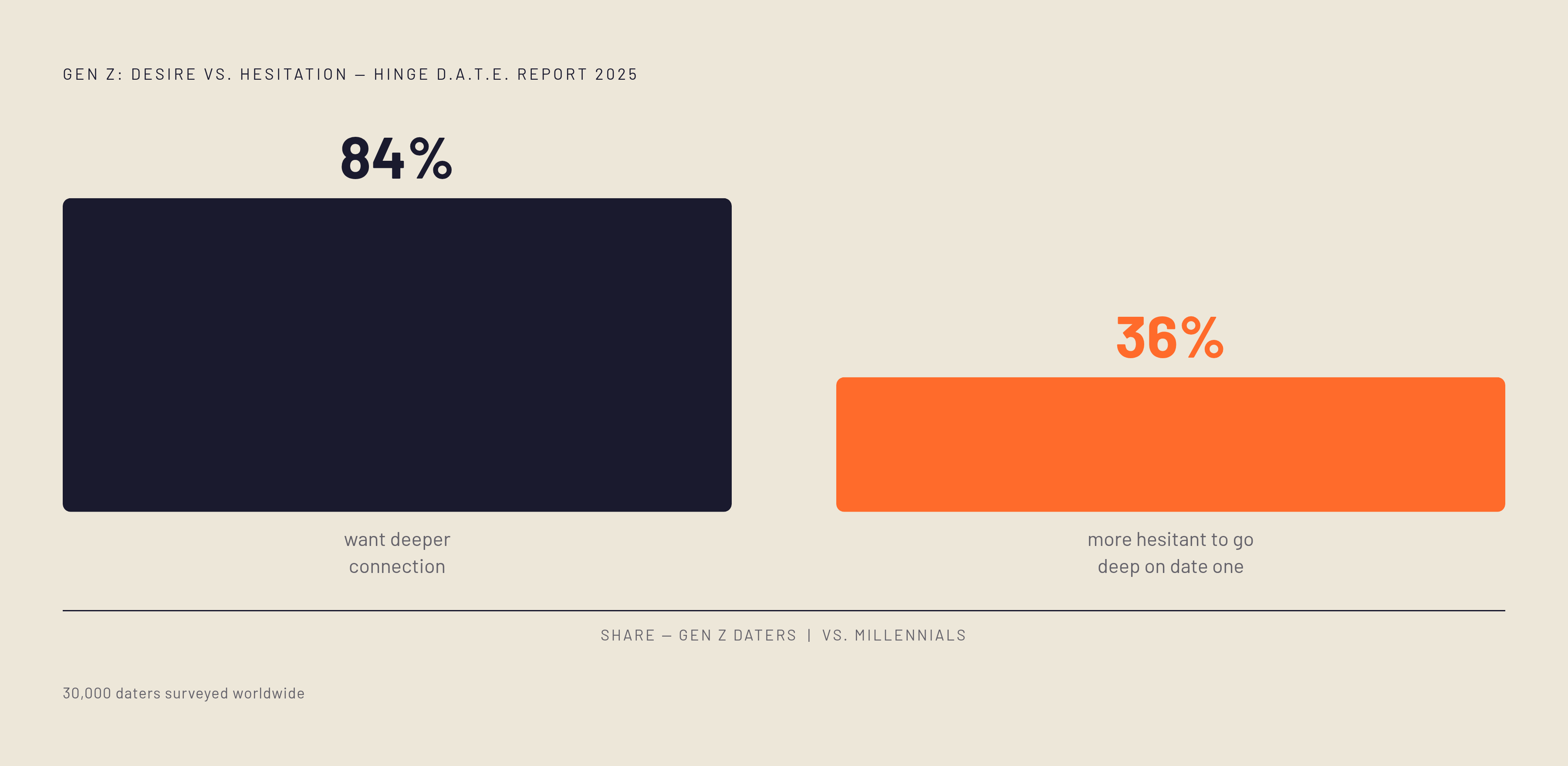
Gen Z wants deeper connection on dates and is measurably worse at going after it than the generation just ahead of them, and the reason has less to do with what they value than with a specific, trainable skill they never got enough reps to build. Hinge's 2025 Gen Z D.A.T.E. Report, built from roughly 30,000 daters surveyed worldwide, found that 84% of Gen Z daters want new ways to build deeper connections, yet this same cohort is 36% more hesitant than millennials to start a deep conversation on a first date. Hinge names this the "Communication Gap" (the disconnect between the deeper connection daters want and their hesitation to begin deep conversations).
That gap could look, on its surface, like a generation that's cooled on romance entirely. That is not what it looks like. The desire is intact, arguably more intact than the stereotype gives it credit for. What's missing isn't the wanting. It's the doing, and that distinction matters, because a motivation problem and a behavioral one call for entirely different fixes.
If the want is there and the execution isn't, what exactly sits between them? That's the actual question this piece is trying to answer, and it's not going to land on "Gen Z is bad at dating" as a satisfying conclusion, because that explains nothing. A skill deficit is diagnosable. It has a traceable cause and, more usefully, a fix. Treating it as some vague generational failing is the laziest read available, and also, conveniently, the least useful one. Hinge's Gen Z D.A.T.E. This is not a values problem or a commitment problem: a Tinder/Harris Poll survey of 2,500 U.S. singles ages 18–79 found 80% of Gen Z singles believe they will find true love and 74% believe they will get married. The desire is real.
How growing up on screens left a speaking gap where dating confidence should be
Only 25% felt confident approaching someone they were interested in, only 34% felt comfortable discussing feelings, and only 36% felt good at reading dating social cues. None of those numbers describe a lack of interest. They describe an untrained muscle.
The mechanism explains the "why" better than any generational-vibes explanation could. Older generations built conversational confidence through a slow, humiliating apprenticeship: awkward phone calls and hallway small talk, where you say the wrong thing, survive it, and learn the world doesn't end. Gen Z built the digital equivalent instead, honed almost entirely through screens, where every message can be drafted, reworded, and deleted before anyone sees it. That's not a character flaw. It's a different training environment, one that optimized for a different skill: editing, not speaking.
Maryellen MacDonald, professor emerita at UW-Madison and author of "More Than Words," told the Washington Post in January 2026 that today's young adults struggle with tasks as basic as making an appointment, asking a question aloud, or disputing a bill over the phone. Phone anxiety, in other words, isn't really about phones. The same underlying gap shows up in a different context, producing this symptom. Even the so-called "Gen Z stare," the flat, unreadable expression that's become a minor internet punchline, reads less like a personality trait and more like a learned adaptation: face-to-face dialogue demands split-second executive functioning and real-time emotional feedback that texting simply never asked for.
So here's the reframe the rest of this piece leans on: digital communication didn't make anyone bad at connecting. It made live, unscripted, unedited conversation feel abnormally high-stakes, since almost nothing else in a Gen Z social diet has trained them for the discomfort of a live mic. High-stakes and impossible are not the same thing, though. The scarier-sounding issue hides a more solvable one. And Gen Z knows it: 54% say young people lack confidence meeting new people, and 91% want colleges to actively help close the gap, which suggests this isn't a population in denial. It's a population that's noticed the problem and hasn't been handed a fix yet. Per Shaunti Feldhahn's May 2026 article series, citing an external report, roughly two-thirds of singles age 22–35 did not feel confident in basic dating abilities.
The specific ways the confidence gap plays out on actual dates
Hinge's report names a specific symptom of the larger gap: the Question Deficit. About 62% of heterosexual and 61% of LGBTQIA+ Gen Z daters believe they ask enough questions on a first date. Everyone thinks they're the one carrying the conversation. Almost nobody feels carried.
The cost of that mismatch isn't abstract. Asking thoughtful questions makes a dater 85% more likely to want a second date, which turns the Question Deficit from an awkward-silence problem into a direct hit on romantic outcomes.
Gendered scripts make the silence worse. Among heterosexual Gen Z daters, 49% of women hesitate to start a deep conversation because they're waiting for the man to go first, while only 17% of men report the same hesitation NovoResume. And yet 65% of heterosexual men say they actually want meaningful conversation early on, while 42% of women assume the opposite is true NovoResume. That's not a compatibility problem. That's a communication failure with a script attached, and the script is wrong on both sides.
Then there's the vulnerability hangover, which sounds like a Hinge marketing term and is, but the data behind it shows 52% of daters have felt ashamed after being emotionally open with someone, while only 19% felt uncomfortable receiving that same openness from someone else. People consistently overestimate how badly their own vulnerability will land and underestimate how welcome someone else's is. Nearly half of Gen Z men, 48%, hold back from emotional intimacy specifically because they don't want to come across as "too much," which quietly suppresses the exact behavior that would get them the connection they're after. As Moe Ari Brown, LMFT and Hinge's Love and Connection Expert, puts it, a mismatch between how someone thinks they should act and how they actually want to act tends to produce dates that satisfy nobody.
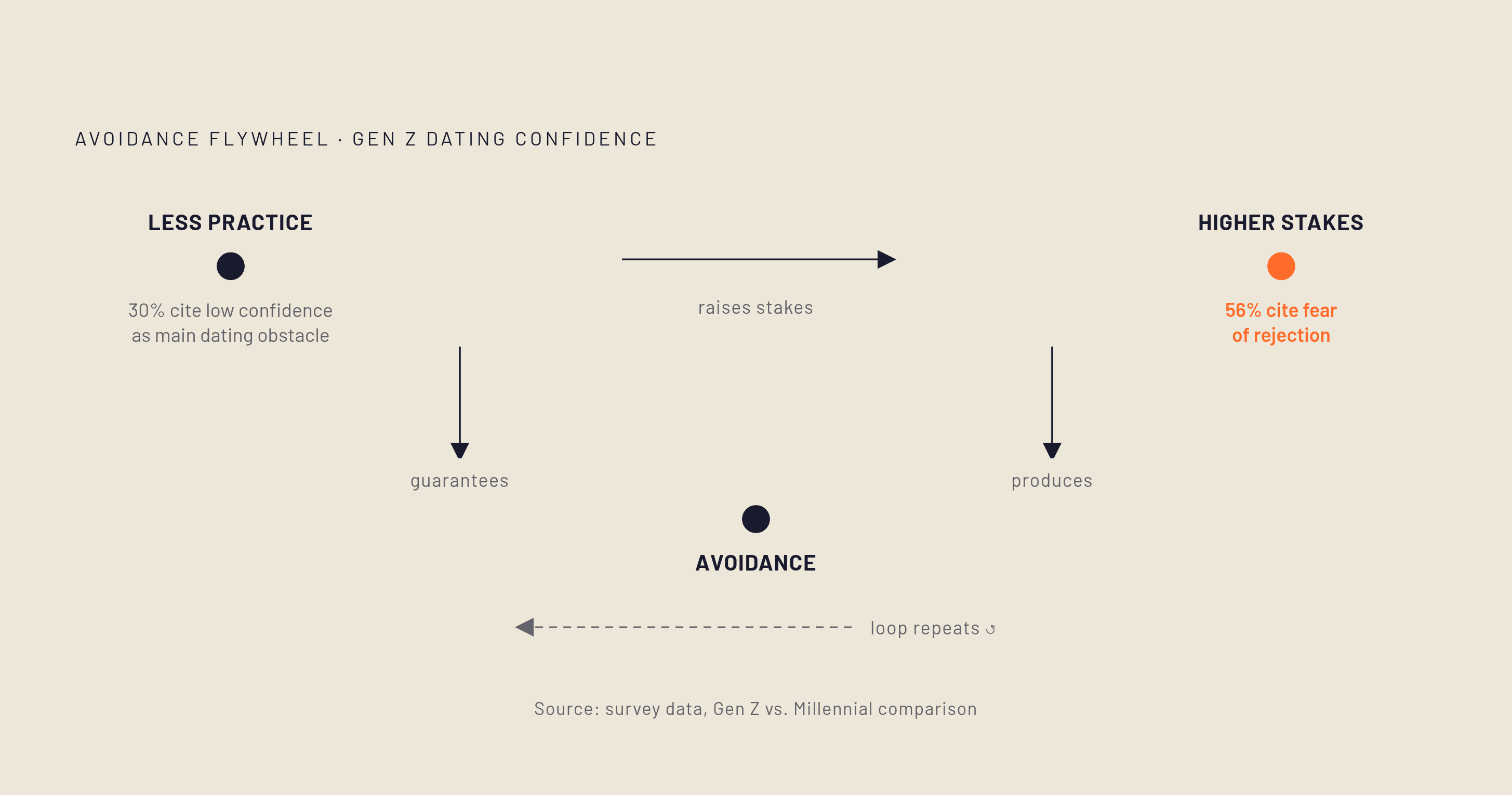
The result is a loop, and not a particularly generous one. About 30% of Gen Z name low confidence as their main obstacle to dating, roughly double the millennial rate, and 56% cite fear of rejection as what keeps them from pursuing a relationship at all Marriage Science Gen Z Dating Statistics. Less practice raises the stakes of the next attempt, the higher stakes produce more avoidance, and the avoidance guarantees even less practice. It's a flywheel, spinning in the wrong direction.
Why this is a speaking problem, not a dating problem
Strip the romantic context away entirely and the same deficit is still sitting there. A CNBC and SurveyMonkey survey from August 2026 found that 62% of respondents, including 59% of Gen Z itself, said active listening is the skill most conspicuously missing in young people. Active listening isn't a dating skill. It's a conversation skill that happens to become excruciating on a date, because a date is one of the few remaining social settings where you can't check your phone to buy time.
Clinical psychologist Sabrina Romanoff told CNBC in September 2026 that in-person communication has become genuinely uncertain territory for a lot of people, in part because the constant availability of digital assistance never forced the in-person muscle to develop on its own. AI and messaging tools are useful precisely because they buy response time, letting someone draft, reconsider, and polish before hitting send, and that same convenience has quietly eroded in-person social fluency across every generation studied, not just the youngest one.
The deficit isn't contained to romance, either. A RiseGuide survey from August 2026, sampling 2,000 people, found 42% of Gen Z and millennials avoid answering phone calls altogether, and 58% script or rehearse conversations before making them. Among people who avoid spoken conversation as a habit, 78% say it has cost them money or opportunity. The same gap that stalls a first date is visible in an unmade phone call to a landlord, or in a negotiation nobody had the nerve to start.
Which leads to the useful part. If the cause were a values problem, therapy or a pep talk might be the answer. But if the cause is a trainable skill deficit, the fix is unglamorous and specific: practice, repetition, structured feedback. Shaunti Feldhahn said in May 2026 that skills can be taught, they can be practiced with some creativity, and confidence can be built from there. That's not a motivational quote. It's the entire logic the rest of this piece is built on.
The composition and trainability of verbal confidence
Before anyone opens their mouth, the room has already made up part of its mind. Research on first impressions, cited by teleprompter.com in July 2026, found that 70% of people form an impression of a speaker before that speaker has said a single word, and the average window for a strong first impression runs about 27 seconds Teleprompter Public Speaking Statistics. Presence, in other words, precedes content. On a first date, that means posture and eye contact are doing more early work than any clever opening line.
The breakdown of what actually lands in a conversation backs this up. Per novoresume.com's February 2026 figures, communication splits roughly 55% non-verbal, 38% vocal tone, and only 7% the literal words used. Verbal confidence, then, isn't really about vocabulary or wit. It's a whole-body skill, closer to posture and breath control than to having the right thing to say.
This should be genuinely reassuring, though. Effective Presentations, a firm that reports having coached over 100,000 professionals, found in recorded practice sessions that the moments speakers were most embarrassed by (a stumble, an unplanned pause) were consistently the moments audiences connected with most. Polish reads as professional. A stumble reads as human, and on a date, human is the entire assignment.
Storytelling helps for a related reason: the brain simply retains a story better than it retains a list of facts, according to effectivepresentations.com's June 2026 research. A specific, well-placed personal story beats a well-curated résumé answer nearly every time, because one is memorable and the other is forgettable in a way that's hard to notice in the moment. Emotional regulation underlies all of it. Per a January 2026 piece from ingramspath.medium.com, confidence appears once the nervous system feels safe enough to let it, and feedback doesn't stick when someone is too tense to absorb it. Inner rehearsal works for the same reason athletes visualize a routine: the mind responds to a vividly imagined scenario in ways that aren't so different from how it responds to the real thing.
The voice is a muscle. Muscles respond to reps, not pep talks.
The practice loop that closes the gap: what structured verbal training looks like
Most individuals see noticeable improvement within 6 to 12 weeks of consistent, structured practice, per masteringconflict.com's March 2026 findings, and early wins include reduced friction in difficult conversations, which builds the confidence to take bigger verbal risks Mastering Conflict. Nobody needs a year. They need a routine, and a fairly small one at that.
The core principle, cited by fyxer.com in December 2025 by way of Forbes, is that communication improves through self-awareness, repetition, and structured reflection, not through personality or sheer willpower. Low-stakes practice is where the actual skill gets built, which is good news, because it's boring and cheap and doesn't require another human being to be present.
A few specific drills carry an outsized share of the results. One constraint forces a person to find the actual point and cut the rambling, which maps directly onto the discipline a first-date conversation demands. The mirror technique, described by makeheadway.com in March 2026, has someone hold eye contact with their own reflection and talk through a real conversation as if the person were there, and practicing this twice a week is cited as enough to start producing results NovoResume. That one directly targets the 55% of communication that's non-verbal, which happens before a word is even spoken NovoResume.
A speech analysis habit worth adding is monthly. Pick a famous speech, break down what actually made it work (the story structure, the rhetorical turns, the pacing) and try importing one specific technique into your own delivery, a method described by mauricedecastro.medium.com in December 2025. It builds something closer to a craftsperson's ear for language than a script to memorize. Recording your own voice and playing it back helps too, since most people are consistently surprised, usually unpleasantly, by how they actually sound compared to how they imagined they sounded.
None of this requires marathon sessions. Frequency beats duration. It's the athletic model, applied to the mouth instead of the legs, and it's a genuinely funny place to land after all that data, but there it is.
What changes on dates when verbal confidence is built
Hinge's research points to three specific verbal moves that reliably produce more connection, and none of them require charisma. First, following up on something the other person said earlier in the conversation gets a 61% positive response rate. Second, asking what someone thinks rather than what they do, since opinions open a door that résumé questions close. Third, the "answer, then reflect back" technique, where the answer gets turned back around into a question of its own, rather than assuming silence signals comfort.
These aren't pickup lines. They're habits, and the gap between someone who's practiced conversation and someone who hasn't is visible exactly in whether these moves are available automatically, under social pressure, without having to think about them first.
As Logan Ury, Hinge's Lead Relationship Scientist, put it, the Communication Gap isn't a permanent condition. It's an invitation to be the one who goes first, who asks something sharper, who chooses vulnerability over the illusion that staying quiet is safer. And the vulnerability hangover dissolves with reps the same way stage fright does: Moe Ari Brown recommends practicing small disclosures in trusted, low-stakes spaces until the nervous system learns that vulnerability isn't actually dangerous, just uncomfortable.
There's already evidence Gen Z is leaning toward tools built for exactly this.
None of this demands a personality transplant. The person who asks the follow-up question, who shares something real without editing it into a highlight reel first, isn't working from more natural courage than anyone else at the table. They've just logged more reps at a skill that was always trainable, and never actually about romance in the first place. Gen Z is already moving toward tools that support this, per Hinge's report: 35% of Gen Z daters want to receive more Voice Notes from people they're talking to, 67% want to build romantic connections without relying on alcohol, and 60% of younger Gen Z (18–22) are open to using AI for dating help as a virtual second opinion. The appetite for verbal tools is already there. BLK data from 2026 anticipates a 32% increase in matches and a 32% increase in messages on Dating Sunday (intentional engagement at scale), suggesting the cultural momentum is already tilting toward doing the work BLK/Ebony.
Sources
- Hinge’s New D.A.T.E. Report: How Gen Z Daters Can Close The Communication Gap in 2026 | Hinge
- Gen Z is just as confident in their social skills as older generations: CNBC survey
- Why Gen Z is dating intentionally in 2026
- What Happened to Dating? How To Build Confidence in Dating Skills (Part 2) • Shaunti Feldhahn
- Gen Z Dating Statistics (2026): Why Gen Z Dates Less