What to Say in the First 60 Seconds of a Job Interview
Open with your current role and a concrete result, then explain your relevant background.

The first 60 seconds of a job interview are a rehearsable verbal performance. The answer opens with your current work and a concrete result, explains the relevant thread in your background, and closes with why this role fits. Then practice aloud, using recordings, honest feedback, or a speaking-confidence app such as Yapp to make the answer sound natural under pressure.
Why the first 60 seconds of a job interview function as a live verbal performance
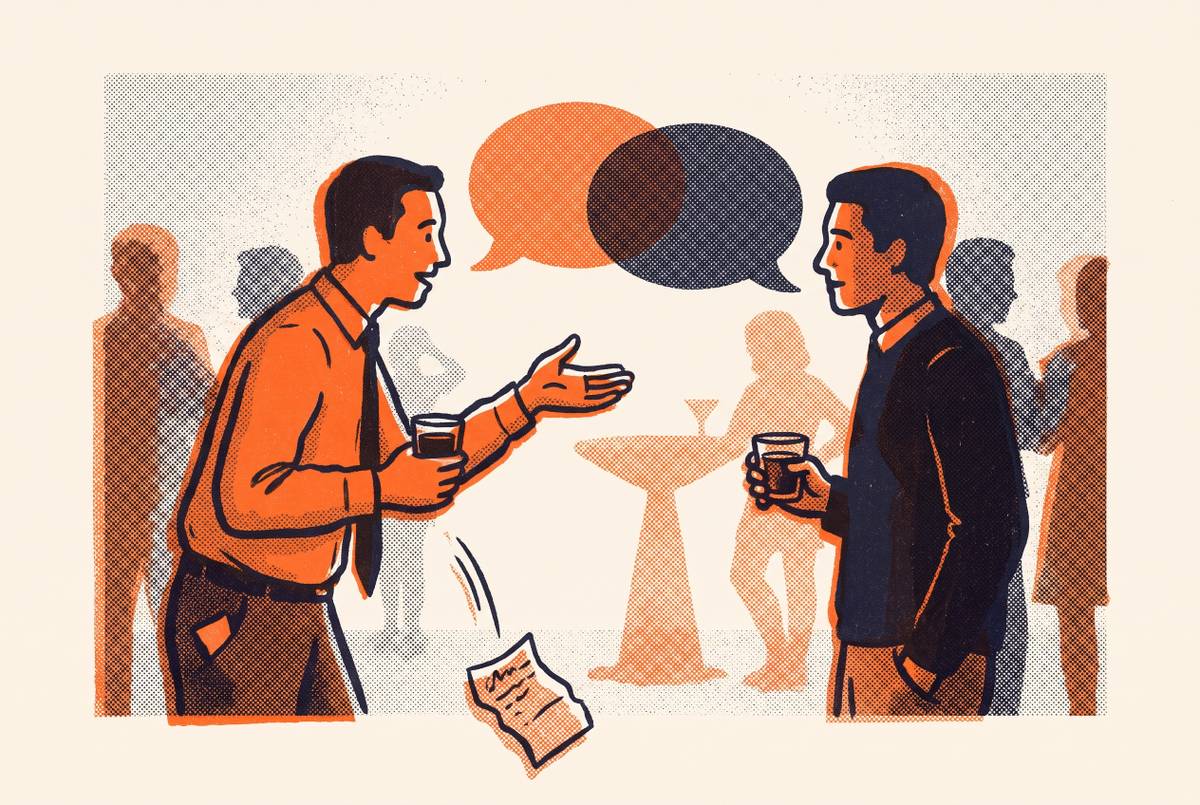
An interviewer starts forming an impression before the substance of your experience has had much time to emerge. Your pace, physical arrival, and opening sentence all become part of that impression. You therefore need to deliver the right information clearly while someone is assessing you. That makes the opening a performance, though not an invitation to become someone else.
The stakes come partly from confirmation bias. Dougherty et al.’s 1994 research on interviews found that first impressions lead to confirmatory interviewer behavior. When the first impression is good, later answers can be heard in that light, while a weak one can leave the candidate working to change the interviewer’s mind. The opening can make the rest of the conversation easier or harder.
In an AI-screened process, that opening may also have another audience before a human listens. Screening tools can parse structure, keyword alignment, and pacing, so the answer needs both human relevance and machine-readable organization. Writing the script with care helps meet those needs without turning the candidate into a résumé with a speaker attached. The useful distinction is between preparing a performance and pretending to have a different personality. The mechanics of a great opening are completely learnable.
The three moments that happen before "Tell me about yourself" is even asked
Preparation starts with the arrival sequence. That sequence has three moments, namely the arrival and check-in, the walk across the room, and the handshake and greeting. Candidates who rehearse only their answer leave these transitions unprepared. Yet the interviewer encounters the person before hearing the pitch. Body language is the channel through which the words arrive.
Start by including arrival and check-in in the rehearsal. For the walk across the room, keep your shoulders back and your pace unhurried, neither rushing nor shuffling. Make eye contact before reaching handshake distance. Then keep the handshake firm, brief, and warm. The spoken greeting needs little ornament, just the interviewer’s name and a clear, genuine expression of pleasure at being there.
These actions give preparation something more useful than the instruction to “look confident.” They specify what the body should do, which makes them possible to repeat. The same principle applies when the setting changes. In a virtual interview, physical cues need slightly more deliberate emphasis because there is no shared room to carry them. In a panel interview, rotate eye contact across the interviewers.
None of this replaces a strong answer. It gives that answer a prepared entrance instead of an awkward handover from movement to speech. Once seated, the task changes from arriving well to explaining yourself well. The verbal opening is where preparation must become a clear account of your relevance.
The Present–Past–Future structure and what to actually say
The present establishes what you do now, the past explains how your experience became relevant, and the future connects that experience to this opportunity. Instead of waiting through your chronology to discover the point, the listener knows what the history is meant to explain. Each part therefore has a different job.
Keep the present brief, saying what your role is now, what you are mainly responsible for, and one concrete result. Spend a little longer on the past, but choose which parts to include. Two or three stepping stones should show the problem you have helped solve across your work, leaving out the rest of your résumé. If an employment gap belongs in that explanation, address it briefly and neutrally.
For an experienced professional, the worked pattern is current role, main responsibility, and result, followed by the earlier work that explains that capability, then the employer’s stated need. If the posting emphasizes “cross-functional collaboration,” connect that phrase to relevant responsibility and evidence. For an early-career candidate, the pattern remains the same, but the opening establishes the candidate’s current stage and the relevant responsibility and result they can substantiate. The middle then selects the background that explains readiness, rather than trying to imitate a long employment history. Both versions close by connecting that evidence to this particular role.
These are adaptable answer patterns. The specific nouns and results must come from your own background. Pull out the two or three requirements that appear most prominently in the posting and address at least two directly. Mirror the posting’s language where it accurately describes your experience, which signals relevance to a person and can improve matching in an AI-screened process.
The future should be brief and intentional. Explain why this company and this role follow from the work you have just described. Structure, however, is only half the equation. Clear delivery helps the connection land.
The delivery mechanics that separate a scripted answer from a natural one
The first sentence establishes the listener’s baseline for your delivery. A fast, high-pitched start can make the answer sound nervous even if the pace later settles. Deliberately slowing that first sentence is therefore a small correction with considerable leverage. Let the statement of your current work carry its own weight. It does not need a running start.
A brief pause after the question serves a similar purpose. What feels conspicuous to the speaker can sound composed to the listener. Fillers such as “um,” “like,” and “so” can instead make strong content sound uncertain. The correction is to practice allowing a pause to do the work that a filler was doing.
Announcing nervousness makes anxiety the frame before your experience has arrived, while asking what the interviewer would like to know hands back the task you were invited to perform. Start with professional relevance instead of hobbies, family circumstances, or where you grew up. Show what you have done to back up claims about being hardworking or passionate. A result gives the interviewer something to judge, while an adjective asks them to take your word for it.
But does scripting make an answer sound scripted? Only if rehearsal stops at memorizing sentences that work on paper. Record the answer and adjust wording until it sounds like something you would say to a person. A script should function as a handrail.
Recordings, another person’s reactions, or scored speaking practice can help you judge how you sound. With a tool such as Yapp, immediate feedback adds a repeatable assessment to that process rather than leaving progress entirely to how confident a take felt. Pace, pauses, fillers, and presence are correctable habits. Even when those habits have names, they can be hard to change under pressure.
Why Gen Z and younger millennials face a specific register problem in this moment
For many younger candidates, the difficulty is a shortage of practice in the particular spoken register an interview requires. Text, voice notes, and short-form video each have their own rules, which differ from those for a formal answer at work. Fluency in those settings does not automatically transfer to a concise explanation delivered to someone assessing your suitability.
A digital-first environment has meant fewer opportunities for some younger candidates to practice in-person professional exchanges. The pandemic also compressed the period in which younger workers would ordinarily absorb workplace conventions through proximity and observation. That matters because much of this learning happens by hearing how other people frame responsibility, evidence, and uncertainty. Without those repetitions, the formal register can feel unfamiliar even when the underlying experience is sound. Asking someone to “just be confident” does not supply the missing practice.
Gen Z’s strengths, including authenticity, comfort with technology, and willingness to name what they are still learning, can remain strengths in an interview. They simply need a form that lets the listener understand them. Honesty about a growth area can sound grounded when it is brief and structured. The same honesty can sound like uncertainty when it arrives as an apology followed by an unbounded explanation.
Younger millennials can encounter a different version of the same mismatch, including overexplaining, giving too much background, or hedging before reaching the point. These are possible habits to correct. In both cases, the practical question is the same. Can the candidate move into clear professional speech when the setting calls for it? Deliberate daily practice makes that switch more familiar, and its effects can be measured.
How deliberate daily practice closes the gap between knowing the structure and owning it under pressure
Knowing the framework reduces uncertainty about what belongs in the answer. Speaking it aloud repeatedly reduces the effort of retrieving it. That distinction matters under pressure, when remembering the next sentence can compete with listening to the interviewer. As retrieval becomes easier, more attention is available for adapting and connecting. Confidence grows as those skills grow, so it is not needed at the start.
Begin with the concrete practice protocol of recording a 90-second answer. Treat that as a draft to refine toward the 60-second opening. Watch it first with the sound off to assess body language, then with the sound on to catch fillers and hear the pacing. Choose one thing to fix the next time you practice. That might be slowing the first sentence, reducing fillers, or trimming the past section.
Repeating an answer without a target can simply repeat its weaknesses. A narrower goal makes the next take assessable against the previous one. Short daily sessions give changes more chances to feel familiar than one long cramming session does. If the interview is next week, the useful aim is not to feel transformed overnight but to make each rehearsal solve a defined problem.
Feedback can come from watching the recording, practicing with someone who gives honest reactions, or using an app that scores speaking. Yapp gives you one daily prompt, up to three recorded takes, and an instant 0–100 score, with the best take winning. This gives ambitious students and young professionals a short way to practice speaking that they can repeat before an interview or presentation. Its role is to support the repetitions while you tailor an answer to an actual job. A score is most useful when the candidate can connect feedback to something correctable in the next take.
Practice should make the structure available even when attention is divided and someone is assessing you. The skill being built is organizing relevant information while another person is listening.
Why mastering the 60-second verbal opening pays off well beyond the interview room
That ability travels well beyond hiring. A client pitch, a team meeting, and a request to explain your work under pressure all call for clarity, selection, and controlled delivery. The interview opening is a useful starting point because it is both high-pressure and predictable. You know the kind of task coming, so you can train the response without pretending to control the entire conversation. Preparation becomes portable.
The World Economic Forum’s Future of Jobs Report 2025 identified AI and big data, networks and cybersecurity, technological literacy, and creative thinking among the skills expected to see the fastest growth in employer demand through 2030. That changing landscape makes explaining relevant capability an important part of bringing it into the room. Knowledge still needs an intelligible account of what it can do.
The opening minute is therefore more than an interview trick. It is a compact practice ground for speaking with purpose when the audience matters. The structure selects the content, the delivery makes it accessible, and the feedback tells you what to change. What separates knowing those principles from using them under pressure is repetition. Record the next answer, fix one thing, and try again.